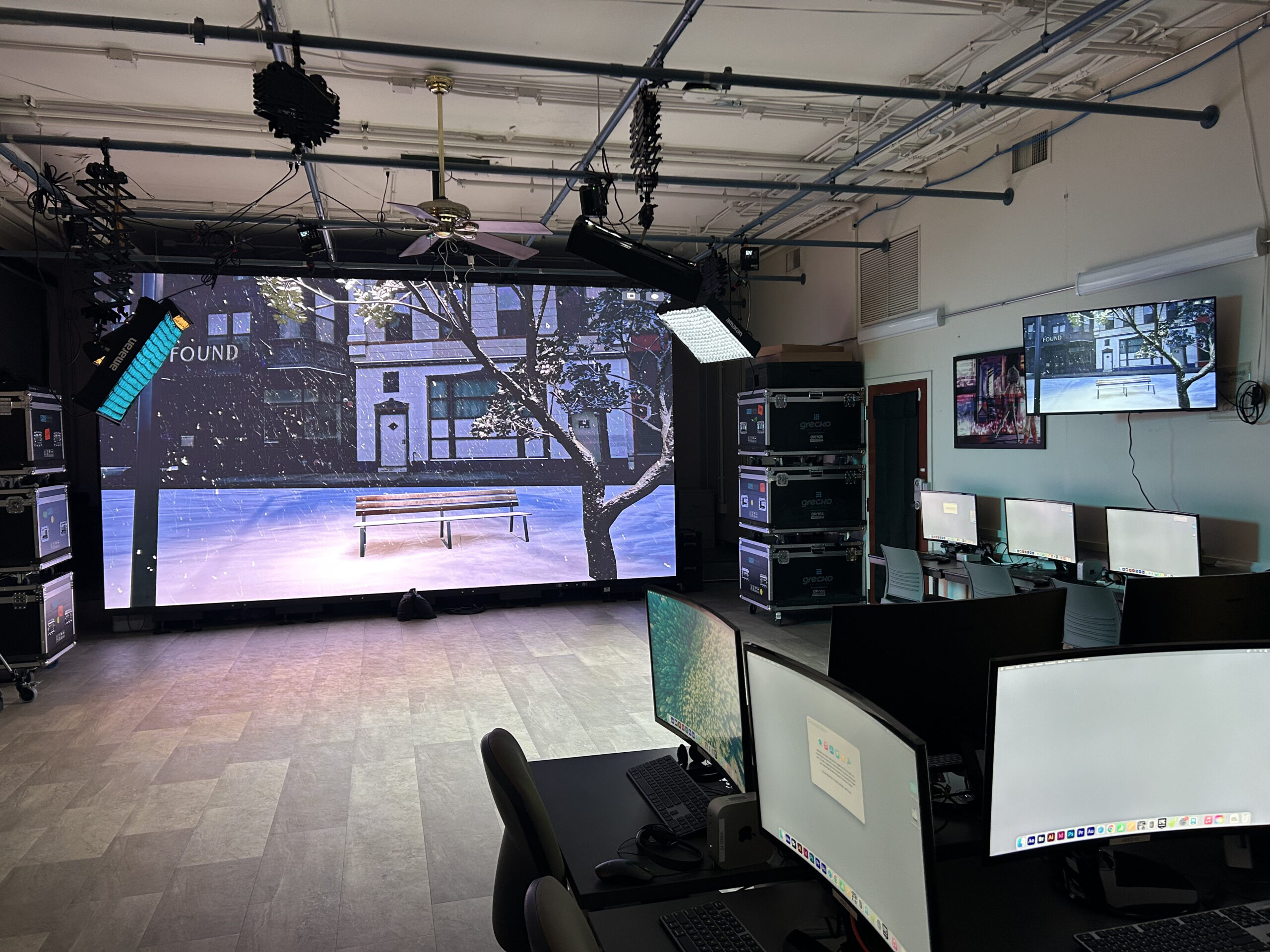
Photo of the new TV studio in the SXU student media center The Xavierite
Over the summer, room CMC 107 in the Saint Xavier University (SXU) student media center was transformed from a classroom into a television studio that is accessible to all SXU students, specifically those interested in film production.
Renovation on the room began shortly after the end of the 2024-2025 school year, and ended before this school year began. In prior years, the room was likely used as a television studio or something of the like, as suggested by the pipes on the ceiling, which would have been used to hang lights.
The project’s completion is largely a result of the work of Nathan Peck, who has been a full-time professor of digital art at SXU since 2001. A main motivator, according to Peck, in creating the TV studio was to give students an adequate space for video production.
As Peck explained it, a space designated for video production is especially necessary because of the new Game Design and Motion Graphics major here at SXU.
“It’s a very integral part, you need somewhere to build video production. Of course, the Communications department already does video production, but usually in a room not designed for it,” Peck stated. “There is a big difference between doing location shooting and video and being able to do studio production and video,” he later clarified.
In addition to a perceived need for this space, funding to science, technology, engineering, and mathematics (STEM) programs on campus allowed the project to come to fruition this past summer.
“Art isn’t something you normally think of when you think of STEM, but art does teach a lot of technology classes. Technology isn’t a specific major here, like mathematics or science, but it is a category of study, and technology has been central to what art has been about forever,” Peck stated, explaining how funding was able to be utilized to make this change to the student media center.
During this past spring break, Peck created a less advanced version of what the TV studio is today to see not only if students would use it, but to show the university what could be done with the space.
“While [the temporary studio] was up, we had an opportunity to talk to the grant people, and sort of say, ‘What if we took this to a whole other level up?’” Peck tells of his experience acquiring grant money for the studio. “And, basically, the three things we thought could make the biggest difference is brand new computers, a giant video wall, and a couple of additional cameras and a couple of additional lights. And, so, because we had [this temporary studio] up, we could ask for [a permanent one],” he further explained.
Though Peck was one of the main people involved in this process, he attributes the help of many collaborators to the completion of the TV studio, such as the professors in the Communication department and Facilities Director Peter Skach, the latter of which ensured the space could be transformed into what it is today.
“Collaboration is central to our success as a community, on campus and the rest of the world. Being able to work with people that you maybe would not have worked with normally and expanding the horizon of people you can work with is the single most important thing you have to learn in college,” Peck stated when speaking about the collaborative aspect of building the studio. “The more people you can work with, the more you can accomplish,” he further stated.
The TV studio will also remain a functioning classroom with fifteen seats, each at a desk accompanied by a McIntosh computer.