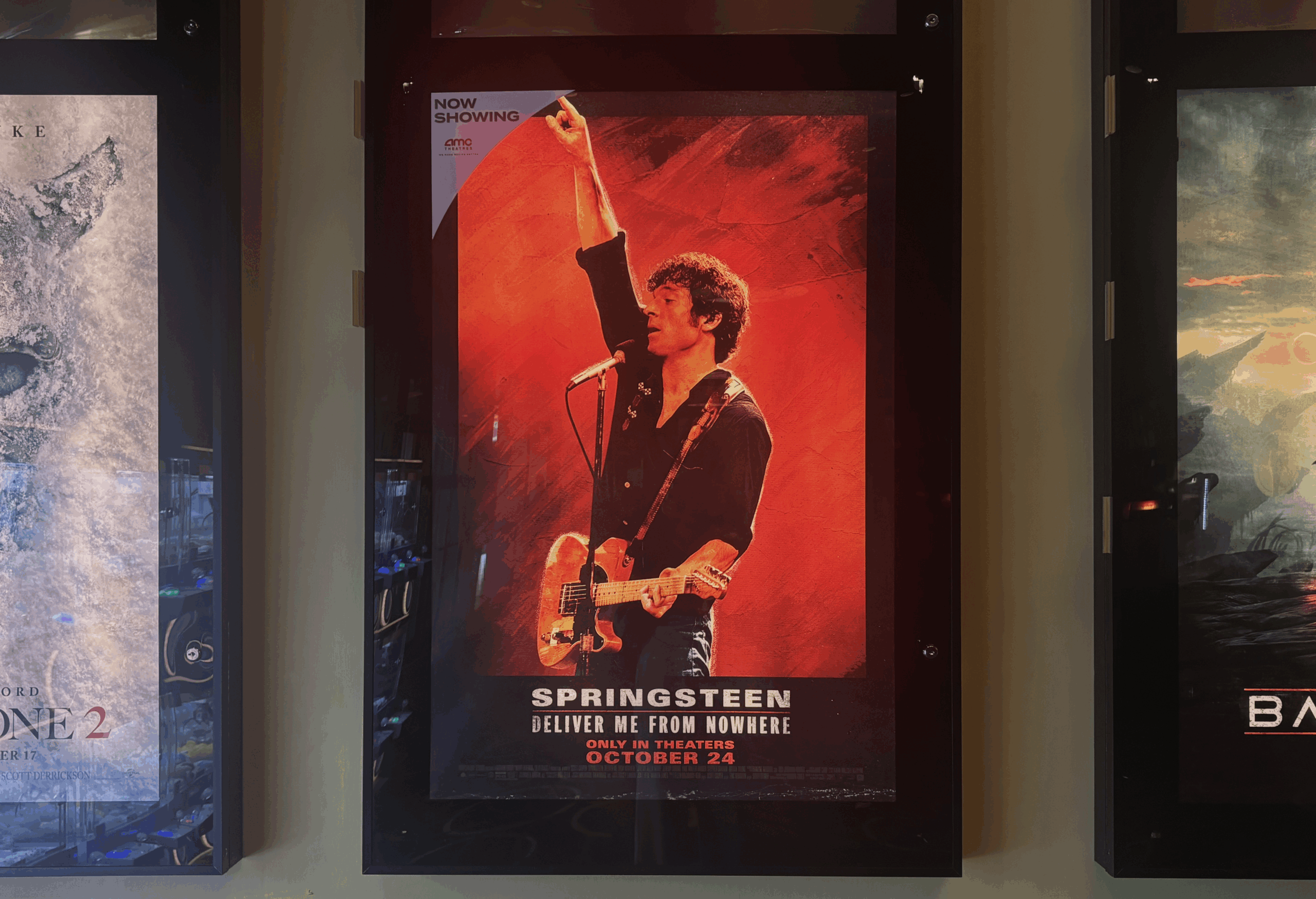
“Springsteen: Deliver Me from Nowhere” poster at the theater The Xavierite
Before this year, I didn’t consider myself a Bruce Springsteen fan. I knew of him, of course, but my knowledge didn’t go much farther than “Born in the U.S.A.” and a couple other hits.
When I heard Jeremy Allen White would be playing him in an upcoming biopic, I wanted to get more familiar with his music. I’ve loved White as an actor since his early days on “Shameless,” and I knew I’d be seeing this movie. It was just a matter of getting familiar with the subject matter.
Thus began my journey into Springsteen’s extensive discography. I quickly became a fan, but a new fan nonetheless. I didn’t know all the lore or references hidden in his lyrics, so I was still wary of how engaging the movie would be for me.
I went to see “Springsteen: Deliver Me from Nowhere” during its opening weekend, and I was pleasantly surprised with the story the film told. However, it wasn’t without its flaws.
One thing the film does exceptionally well is depict an artist in the midst of creation. The movie doesn’t chronicle Springsteen’s whole life, but rather focuses on the period of time when he was writing “Nebraska,” his sixth studio album.
“Nebraska” marked a turning point in Springsteen’s career. The songs aren’t the stadium-speaker anthems he’s known for. They’re darker and full of haunting self-reflection, which made for an interesting backdrop to set the film against.
The film’s choice to center on this period in Springsteen’s life is a clever one. It shows a side of Springsteen not many have seen before, and it gives the audience a peek into one legendary songwriter’s mind.
Maybe it’s because I’m a creative person myself, but the depiction of Springsteen’s writing process was one of the more interesting parts of the movie.
The audience is shown where Springsteen gained inspiration for “Nebraska,” from the 1973 crime film “Badlands” to the short stories of Flannery O’Connor. We see him scrawling lyrics in a notebook, scratching out phrases and draft titles as he goes.
These quiet scenes of a creative mind at work gave the film and Springsteen himself the depth I was worried the film would lack. Biopics can lean heavy on clichés and overdone tropes to drive the film’s plot, but this one did a good job of subverting many of them.
I’d much rather watch the meditative scenes where Springsteen’s alone with only his own writing for company than have the film be inundated with flashy sequences of White trying to reenact Springsteen performances.
White was definitely the best choice to play Springsteen for this reason. As he’s shown in previous roles, such as Carmen Berzatto on “The Bear,” White can play a tortured young man without a hitch.
While the film focuses on Springsteen’s process, it also focuses on his mental health. Springsteen’s battled depression throughout his life, and it came to a head during this particular period.
White plays a depressed Springsteen with subtlety and truth. He holds all the tense and restrained emotion in his facial expressions and slight voice inflections. His style is subtle, for the most part, and it works.
Without giving too much away, there are a couple scenes where Springsteen’s controlled emotions become unlatched. White’s portrayal of overwhelming emotion is utterly moving.
Although I enjoyed White’s performance during these scenes, the overall message about mental health seemed flat to me. The message is nothing we haven’t heard before: you’re not alone and help is always available.
This is a valid and important message, but in this day and age it’s a little overdone. I’ve seen plenty of recent films and TV series tackle mental health in this way. Do we really need another?
However, I rethought this critique when I reflected on who the true target audience is.
The film isn’t really for teenage girls who mostly bought their ticket to see Jeremy Allen White. I still enjoyed the film as part of that demographic, but there’s a reason certain parts didn’t feel as illuminating as they should’ve.
Most die-hard Springsteen fans loved him when he was at his peak in the ‘80s, which makes them middle-aged in 2025. They didn’t grow up in a culture overflowing with mental health awareness and therapy-speak.
An X user put it perfectly in a post from Oct. 25. “I thought the film was pretty mid, but when the lights came up I had [three] old white men around me with tears in their eyes so it means something to someone I guess,” the post read.
Even though parts of the film fell flat for me (the simplified depiction of mental health and other cheesy parts of the script), I enjoyed seeing it anyway. Jeremy Allen White gives a stunning performance, and I know the raw portrayal of mental health will resonate with the generation of fans who could benefit from it.
Overall, I’d give the film 3.5 out of 5 stars.