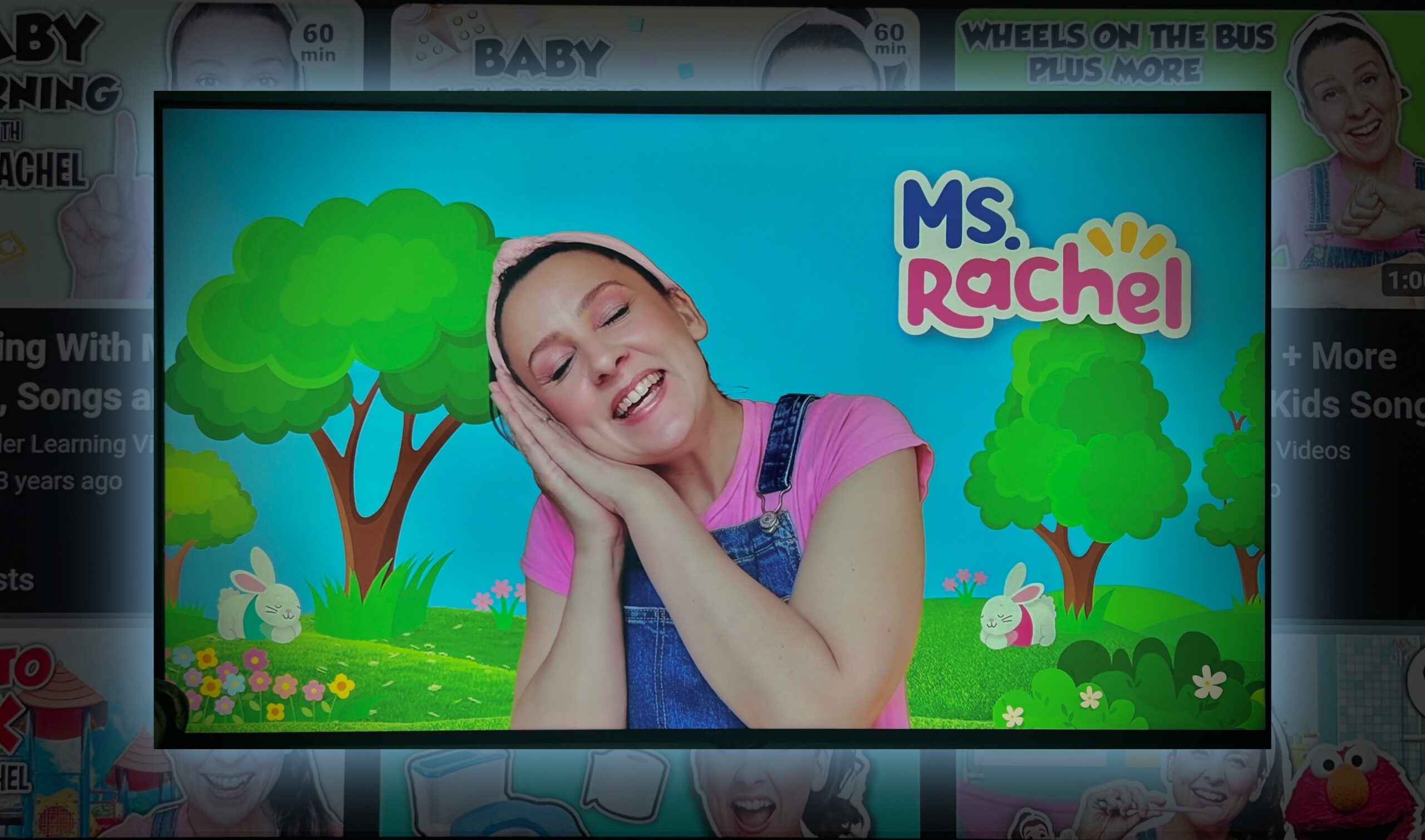
Ms. Rachel’s Youtube channel, The Xavierite
Before she became a household name—the woman behind “Sticky Sticky Bubblegum” and the soothing smile parents rely on during chaotic afternoons—Ms. Rachel was simply Rachel Griffin Accurso, a preschool teacher with a guitar and a belief that children deserve to be met with patience, curiosity, and joy.
Most people know her as a YouTube fixture, the face of toddler-friendly educational content. She has increasingly become something much more: one of the most visible voices for children living through the genocide in Gaza.
In an era when children’s media is often dominated by overstimulating animation and fast cuts, Ms. Rachel has always been an outlier. Her videos are gentle, slow, and rooted in developmental psychology.
She speaks directly to children, naming their emotions, celebrating their efforts, and reassuring them when they struggle. This compassion has recently extended far beyond song-filled playrooms—into the heart of humanitarian advocacy.
Her activism intensified after she watched a video of a small child in Gaza who was visibly shaken after an airstrike. As she told Democracy Now!, her training as an early childhood educator informed her heartbreak: “They need food … They need water … They need medical care … I see precious children … just like I see my children.” Her deep care, she said, doesn’t stop at any border.
From that moment, she committed to using her platform: she raised funds, amplified stories, and formed real relationships.
According to The Guardian, she launched a fundraiser for children in conflict zones—including Gaza—and donated $1 million to the World Food Program USA. She also partnered with the Palestine Children’s Relief Fund (PCRF) to help evacuate and treat injured Gazan children.
One of the most poignant chapters in her advocacy involves a little girl named Rahaf, a three-year-old who lost both her legs in an airstrike. Through PCRF, Ms. Rachel helped bring Rahaf and other children to the U.S. for life-saving medical care. Their friendship, documented in interviews and video, became a powerful symbol of her belief that every child deserves dignity and healing.
Her message came into sharp focus at the 2025 Glamour Women of the Year Awards, where she wore a custom upcycled gown embroidered with artwork by Gazan children. Each sketch—from a dove carrying olive branches to a child hugging a watermelon—carried deep meaning. On the red carpet, she said, “I’m carrying their stories in my heart.”
During her acceptance speech, she named several of the young artists and shared the words of Rana, a child who lost her two sisters. “They [Rana’s sisters] are not numbers,” she quoted Rana. “They shine and sparkle like stars.” The audience rose in a standing ovation—not just for Ms. Rachel, but for the children whose lives their art represented.
Of course, her advocacy hasn’t been without backlash. Some groups have called for investigations into her motivations, and she has publicly acknowledged the criticism. But as she told Democracy Now!, being pressured by critics is secondary to her responsibility to children: “It’s who I am … I love all kids.” She has even said she would risk her career for this work.
What makes Ms. Rachel’s activism so profound is that it feels like a natural extension of her mission. Her videos—gentle, deliberate, and nurturing—reflect a worldview in which every child matters. Wearing the drawings of Gazan children on her dress, raising money, and using her voice to demand dignity for vulnerable young people—these aren’t side projects.
They are part of the same mission that made her YouTube channel beloved.
In a world saturated with performative activism, Ms. Rachel is teaching something deeper: that caring is not passive. It demands attention, empathy, and persistence.
She is reminding us, in her own soft way, that children anywhere are not just abstract victims—they are individual lives with thoughts, pain, hope, and brilliance.
And maybe, just maybe, the real lesson she’s modeling is that early childhood education and global humanitarianism don’t have to live in separate boxes. They can—and must—be intertwined.
For Ms. Rachel, teaching toddlers how to speak and speaking up for the world’s most vulnerable children are part of the same calling.