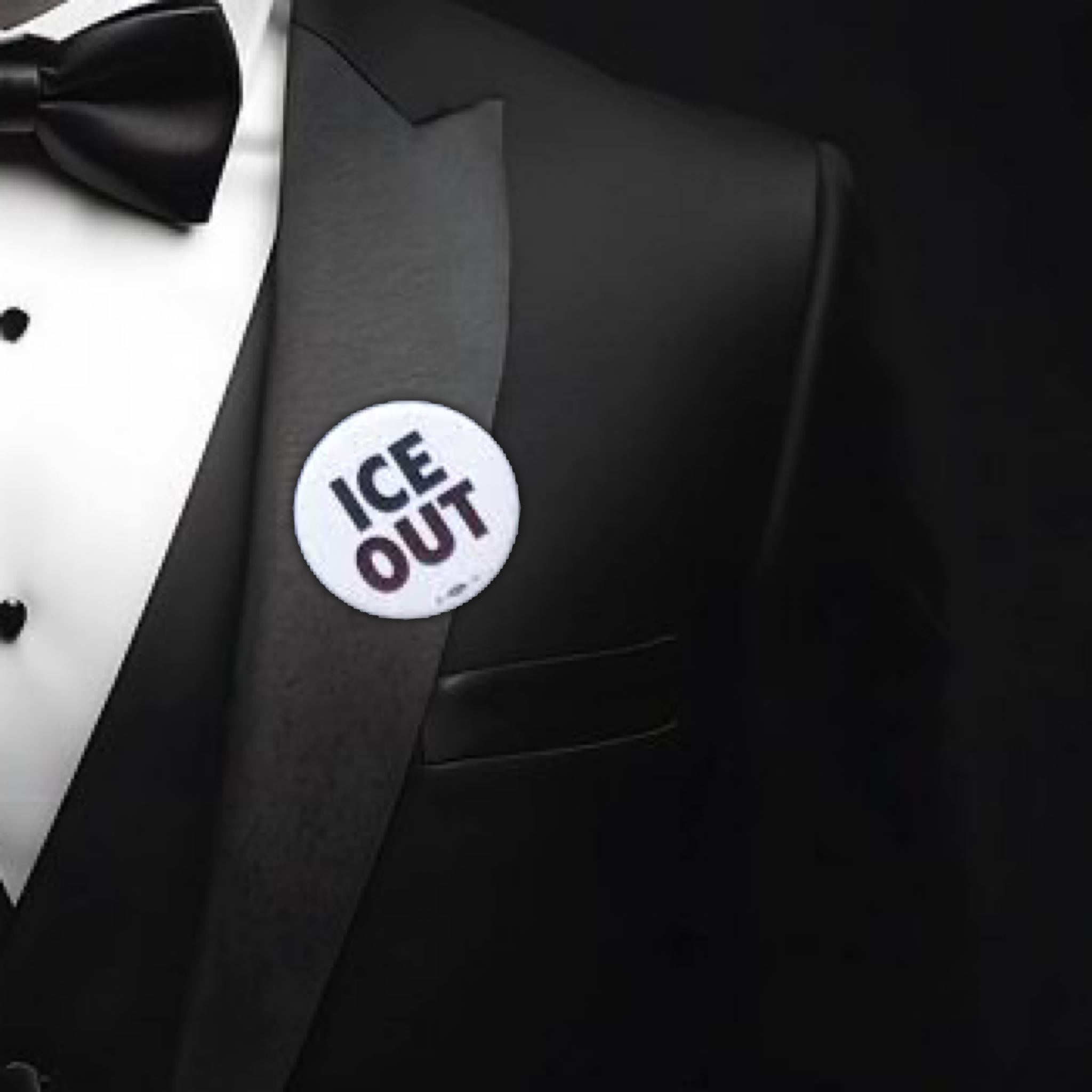
Ice Out button as seen at the Grammys 2026 The Xavierite
There has been no shortage of debate lately over whether art should be political, but the question itself feels misguided.
Art has never existed in a vacuum.
Every song, every performance, every award handed out on a glittering stage is shaped by the social moment in which it exists. Whether subtle or outspoken, all art is political and nowhere is that more evident than at the Grammy Awards.
The Grammys has a long history of using music’s biggest night as a platform for cultural and political expression.
One of the most iconic moments dates back to 1973, when Helen Reddy won Best Female Pop Performance for her feminist anthem “I Am Woman.” She closed her acceptance speech with a line that would echo through Grammy history: “And I would like to thank God, because she makes everything possible.”
More than five decades later, that legacy remains alive; notas an anomaly, but as tradition.
The 2026 Grammy Awards were no different. If anything, they were a reminder that when artists are given a microphone, they will use it to speak to the world they live in.
One of the night’s most powerful statements came in the form of a win that spoke volumes before a word was even said.
Bad Bunny’s “DeBÍ TIRAR MáS FOToS” took home Album of the Year., making It is theit the first Spanish-language album to win the category in the Grammys’ 68-year history.
In a time when immigration rhetoric continues to dominate headlines, the win felt monumental and not just historic, but deeply human.
Bad Bunny, visibly emotional as he took the stage, dedicated the award to those who have had to leave everything behind in pursuit of something better.
“I want to dedicate this award to all the people that had to leave their homeland, their country, to follow their dreams,” he said.
The moment was quiet, reverent, and deeply moving. It serves as a reminder that representation is not symbolic when it’s rooted in lived experience.
Later in the night, the Puerto Rican artist echoed the growing chorus of “ICE OUT” sentiments voiced throughout the ceremony.
“We’re not savage. We’re not animals. We’re not aliens,” he said. “We are humans, and we are Americans.” He urged viewers to fight hate with love, adding, “The only thing that is more powerful than hate is love.” It was a sentiment that resonated far beyond the walls of the arena.
Bad Bunny wasn’t alone either. Political expression wove its way through the entire evening, from the red carpet to the acceptance podium.
Artists including Shaboozey, Kehlani, and Bon Iver made pointed statements in solidarity with Minnesota protesters and against ICE. In the audience, small but unmistakable “ICE OUT” pins dotted lapels and gowns. They were worn by attendees like Justin and Hailey Bieber, Billie Eilish, and Joni Mitchell.
The message was clear: even in an industry often criticized for its silence, artists were choosing visibility.
For Olivia Dean, who won Best New Artist, the politics of the night were deeply personal. “I’m up here as a granddaughter of an immigrant,” she said during her acceptance speech.
“I wouldn’t be here, I’m a product of bravery, and I think those people deserve to be celebrated. We’re nothing without each other.”
The room erupted in applause, underscoring a growing shift in how these moments are received.
Even the show’s humor carried a political edge. Host Trevor Noah, in his sixth and final year of hosting the Grammys, leaned into pointed jokes about President Donald Trump.
At one point, he drew cheers from the audience by noting who wasn’t in attendance: Nicki Minaj. “She is still at the White House with Donald Trump discussing very important issues,” Noah joked.
The jab referenced Minaj’s recent appearance with Trump at the Treasury Department’s Trump Accounts Summit, where he praised her as “the greatest and most successful female rapper in history.”
Later, Noah reflected on his departure as host and CBS’ final year airing the Grammys with another political nod. “I loved my time, but I believe in term limits,” he said, in a clear reference to Trump. “I wanted to set an example for anyone who might be watching the show. Leave when the time is up.”
For as long as artists have taken the stage, there have been calls for them to “stick to the music.” However, music has always told stories of struggle, identity, resistance, and hope. The 2026 Grammys didn’t introduce politics to art; they simply refused to hide it.
As the night came to a close, one fact was undeniable: the Grammys continue to be more than an awards show.
They are a cultural snapshot, a mirror reflecting not only what we listen to, but who we choose to stand with. In 2026, the message is clear: art is speaking, whether we’re ready to listen or not.