
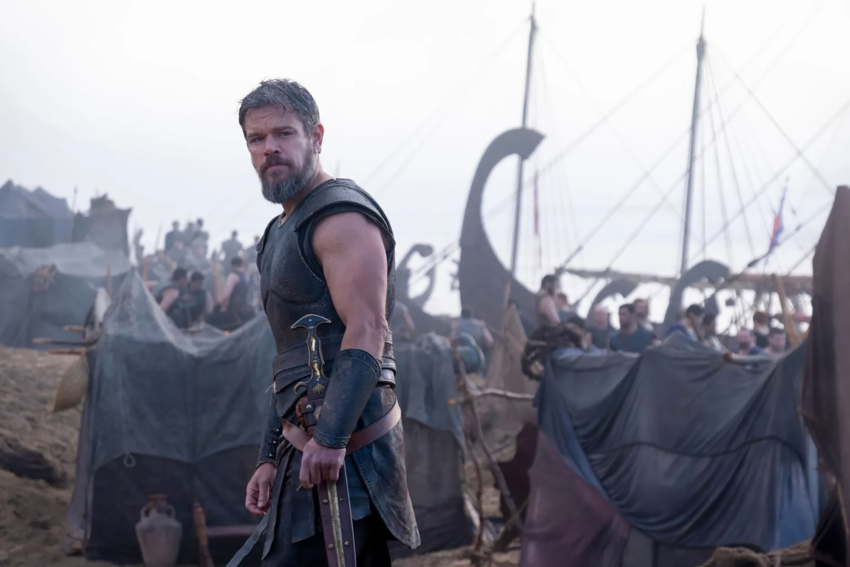
Matt Damon as Odysseus in “The Odyssey.” (Melinda Sue Gordon/Universal Pictures/TNS)
I got a chance to see Christopher Nolan’s “The Odyssey” in IMAX 70MM twice this past summer. Before seeing this movie, I knew this adaptation of Homer’s poem was based on Emily Wilson’s 2017 translation.
My expectations for this movie were quite large, considering how critically acclaimed Nolan’s filmography is: from “Inception,” “The Dark Knight,” and “Interstellar,” Nolan has made a huge impact on films as a whole, so I had major expectations for his interpretation of Homer’s poem.
This film is also a technical marvel, considering that it is the first to be shot entirely in IMAX.
The premise of this film is Odysseus (Matt Damon) and his crew attempting to get back home to Ithaca after they have fought in the Trojan War.
Matt Damon’s performance as Odysseus is phenomenal when you look at his performance with the perspective that Odysseus is a flawed character who has made many wrong choices throughout the story.
Despite the fact that he portrays Odysseus as an arrogant leader, he is also able to portray a side of him that made me feel sympathetic towards him.
The film features an ensemble cast such as Tom Holland as Telemachus, Anne Hathaway as Penelope, and Robert Pattinson as Antinous, to name a few. They all had spectacular performances, and I was engaged throughout the film.
Each actor that I mentioned had a scene-stealing performance, whether it was Robert Pattinson being able to play a snarky antagonist to Tom Holland’s Telemachus or Anne Hathaway, who was able to embody Penelope’s frustration of holding Ithaca together.
Although many actors are featured throughout the film, there were moments when I found myself distracted because I would occasionally think only about the actor and not the character.
The world the film revolves around is beautiful; the set pieces of Troy, Penelope’s home, and the ship Odysseus and his crew travel on are visually stunning.
For a film that takes place in “a time of apparent magic,” Nolan takes a realistic yet stylistic approach with his set design and costumes, which I didn’t mind.
Nolan’s approach to this epic film is more about war PTSD, where you see Odysseus struggle to come to terms with what happened at Troy after being in denial throughout the film.
Nolan also uses the 172-minute runtime as a great pace, despite the movie being told in a non-linear approach. That being Nolan’s signature storytelling, the film finds itself being able to give viewers action-packed moments, balancing the calmer dialogue between characters perfectly.
Ludwig Göransson does the score of this movie, which is a major component that kept me engaged through the film. Göransson doesn’t use modern instruments but rather instruments from the time period the film is set in, making it more engaging and less out of place, like how “The Great Gatsby” uses songs from the 21st century.
“The Odyssey” has many impressive elements, whether it’s from the actors’ performances to the ambitious technical scale this film achieves; the movie excels in questioning if Odysseus is a war hero. This review will contain spoilers from this point forward.
Odysseus made many decisions throughout the film that risked his life and his crew’s lives, whether it was shooting the Cyclops after they had escaped its cave to them taking a detour to Circe’s (Samantha Morton) home to going into the whirlpool knowing it was going to have some casualties.
Odysseus knew that his crew was destined to die when he spoke to his fallen men in Hades, but chose to follow through to save his own life, as he was guaranteed to make it back home.
Viewers are meant to look at Odysseus and realize that he is not a war hero, since he made selfish choices and overall broke Zeus’s law.
Odysseus is in denial of his guilt, which is why we see Athena (Zendaya) appear from time to time, reminding him of the destructive path he is on.
Athena is the only God featured in the film, which is where I see a lot of mixed responses, as Homer’s poem features many more Gods, making some viewers feel they’re only getting half of the story. Despite this issue, I really enjoyed Nolan’s take on focusing more on the humans of “The Odyssey.”
The film has a way of telling viewers why the Gods aren’t in the movie. Athena tells a frustrated Odysseus about how humans won’t understand the Gods and how they can be oblivious, as they don’t acknowledge the water or wind as the Gods talking to the humans.
This allows the viewer to determine what is mythological and what is not, but I interpreted it as a way of the Gods communicating with Odysseus about their frustration with his journey, as he constantly defied the Gods.
I found myself believing in the presence of the Gods heavily, as he gave himself up to Poseidon after blinding his son Cyclops in hopes of returning home to Ithaca safely by letting himself hang onto a part of his ship and go into the storm.
On my second rewatch of the film, I noticed this detail that paid off where Odysseus, at the start of the movie, was teaching his son how to hunt and specifically pluck the bow before hunting their prey to warn them before he hunts.
This pays off before his epic showdown with the suitors, as he pretends to be a beggar and is able to string his bow, alerting the suitors that it’s Odysseus and that he is going to kill all the suitors in the room.
Despite knowing what was to come, I still found myself even more excited as I caught that detail, making the film’s conclusion satisfactory. It’s up to the viewers whether they want to see Odysseus as a hero after the choices he made throughout the film, but I see him as someone who earned redemption by the end.
At its core, “The Odyssey” was able to bring together Nolan’s interpretation of the Homer poem beautifully, successfully executing many aspects of the film. I give this film a 5/5 review. Despite some jarring moments when the characters are introduced, I was quickly able to reel myself back into Nolan’s masterpiece.
About Post Author
