
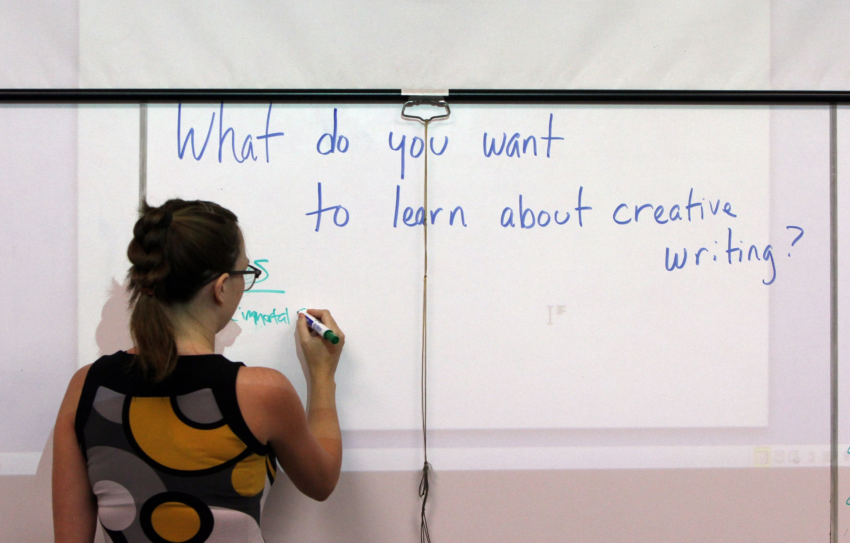
Aimee Campbell teaches part of the creative writing class for teenagers at UCF, July 10, 2012. UCF associate professor Terry Ann Thaxton is teaching middle- and high-school students how to break away from text messages, email style writing, and social media’s quick bursts of information to using more creative styles that will ultimately enhance their literacy, attitude, character and self-awareness.
Ricardo Ramirez Buxeda/Orlando Sentinel/MCT
Starting a new semester can be frustrating and nerve-wracking for students, especially freshmen or transfers who are unfamiliar with the university. The first thing many new and current students check is Rate My Professor (RMP) to see if they’ll be able to survive the semester.
RMP is a website where college students can anonymously review and rate a professor’s performance in the classroom. Believe it or not, this website often affects how students choose their classes.
Many students like to utilize RMP with the reviews on one tab and their catalog of classes on another. As they read reviews from past students, they adjust their schedules accordingly and with confidence believe they have selected the best professors.
But why would one put so much trust in these reviews that they make decisions based on them? The reality is that these reviews should be taken with a grain of salt, maybe even a pound.
Like any other social media platform, RMP is a place where people can hide the things they don’t want others to see. Imperative details are missing in the reviews, like the amount of work they turned in, how long they studied, and if they asked the professor for additional help.
Unfortunately, some students are not very truthful about how they got a bad grade or why they do not like the professor which can negatively affect the professor’s rating. Some lack responsibility or just aren’t mature enough to understand that it’s not possible to like everyone.
Some reviewers may have found the material very difficult, and to them that was enough for them to dislike the class and the professor. However, that isn’t fair to the professor and future students who take the class.
Bad reviews can make a student walk into a class and believe that they will do poorly or fail no matter what. That negative review will linger in the student’s mind, and they will always think poorly of the professor.
Students may think that they are holding professors accountable and helping prospective students make decisions, but without all the necessary information neither of those things can happen.
It’s possible that the student and the professor are just so different that it’s difficult for the student to succeed and for the professor to help.
Professors can also have great reviews because they’re so liked, but students find that they actually don’t teach very well at all. It’s a disadvantage for both the students and the professor because the feedback isn’t coming from a place of logic.
There are times when students don’t have a good reason for their bad review. Many videos show professors reacting to colorful feedback from students.
These videos show that there is some truth to RMP, it just happens to be more difficult for certain professors to admit their mistakes. Maybe that professor could do better at giving instructions, slow down during the lectures to leave enough time for note-taking.
Unfortunately, some reviewers tend to bring up unrelated things about the professor like how attractive or unattractive they are or how difficult the class material is. Although those factors are the reason for the rating for one person, it is not a logical or helpful perspective for others.
Students can have no rhyme or reason for their review, and because of that the professor’s rating suffers.
I myself used RMP to see what I was getting myself into as a first year SXU student. Fortunately, all my professors have great reviews and those reviews hold true so far.
I took the reviews with a grain of salt knowing that my experience can go either way, but luckily the people that reviewed my professors were helpful. If there were more people on the website that reviewed informatively then it would be one of the greatest tools for choosing classes.
While my experiences with my current professors have been positive, someone may feel the complete opposite. For example: I absolutely enjoy my philosophy class and the professor that teaches it, but I know some people that find it boring and overall underwhelming.
This goes to show that experience is what makes a review a review, which means that a professor or a class is not one size fits all. Opinions can come from a place of frustration or disappointment, so reading reviews shouldn’t be the only factor in making decisions.
So what if someone doesn’t like their professor? They can learn from that and apply it to real life, because chances are they will have to work with or learn from someone who knows more than they do in other circumstances.
Professors exist for students to develop into adults who can think for themselves; that’s the whole point of being in college. Seeking further education means facing obstacles even if you’d rather avoid them.
We live in a world where advice is given to help others avoid making mistakes themselves, which defeats the whole purpose of life. Don’t make decisions based on someone else’s opinion, because it is possible to miss out on the best lessons and opportunities for growth.
Reviewers will tell students to avoid certain professors at all costs because struggle is inevitable in that class, and struggle is bad. We can’t just use these reviews to avoid any kind of obstacles we may encounter throughout our college careers.
Give that professor with a bad review a chance, and don’t just rely on RMP while picking out your classes.
About Post Author
