
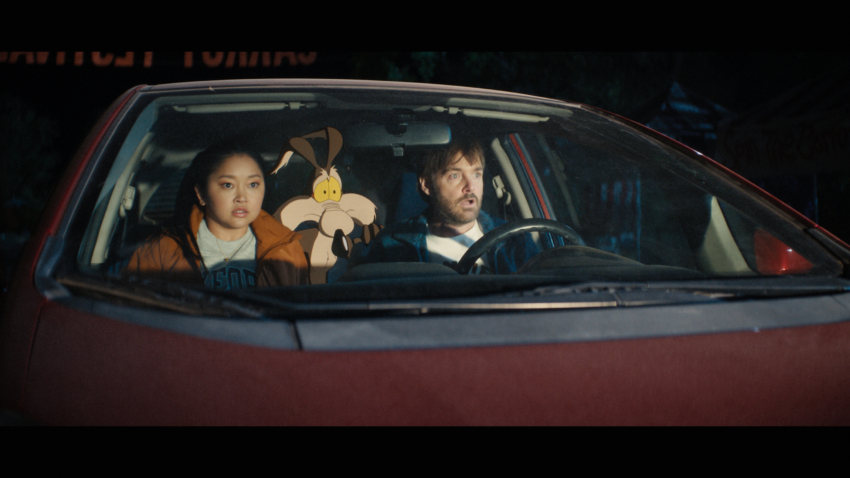
Lana Condor, Wile E. Coyote, and Will Forte in a scene from “Coyote vs. Acme,” set to be released theatrically by Ketchup Entertainment on Aug. 28, 2026.
Ketchup Entertainment/TNS
I got a chance to see “Coyote vs. Acme” in theaters on August 28th. Growing up, I often watched runs of “Looney Tunes” cartoons, and I was familiar with how some “Looney Tunes” movies take a hybrid approach by bringing animated characters into the live-action world, like in “Space Jam.”
This movie sees Coyote trying to capture the Road Runner (voiced by Eric Bauza) yet again, but with rocket roller skates bought from Acme Corporation, a company Coyote constantly buys his gadgets from.
However, as that attempt failed (as usual), Coyote began drafting a new plan to capture Road Runner until he sees an ad for Avery Jones & Maltese, a law firm that sues Acme Corporation in small claims.
Coyote sees this as an opportunity to sue Acme with Kevin Avery (Will Forte) under the claim that Acme intentionally designs their products to fail. This exposition sets the stage for this film to be a legal comedy.
This film is inspired by The New Yorker piece and expands on the piece’s premise to go more in-depth on how this lawsuit impacts the world around the humans and Looney Tunes.
With the hybrid “Looney Tunes” movies, an established trait is to pair the “Looney Tunes” characters with a human. In this film, Kevin and Paige (Lana Condor) complement their polar opposite, Coyote, incredibly well, and not one bit of Forte’s or Condor’s acting feels offbeat.
Despite Coyote being a silent protagonist with his occasional signs, Kevin and Paige work alongside him as they uncover the secrets behind the Acme Corporation.
However, on the side of Acme Corporation, they have their own attorney, Buddy Crane (John Cena), and the CEO of Acme Corporation, Foghorn Leghorn ( voiced by Eric Bauza); both have incredible performances as outright evil.
This movie does keep the “Looney Tunes” charm of slapstick and outlandishly exaggerated humor. Audiences can enjoy the courtroom comedy along with some action sequences, despite some pacing issues around the middle and some slightly corny jokes not landing for me.
“Coyote vs. Acme” doesn’t make Coyote a running gag like he’s been throughout the “Looney Tunes” cartoons, as the film gives audiences a Coyote with emotional depth beyond just being the hungry antagonist of Road Runner.
What shocked me the most with this film is that, despite it being a comedy audiences can easily follow, it does handle the underlying themes seriously.
This review will contain spoilers from this point forward.
The main centerpiece of this movie is how it tackles corporate greed through the Acme Corporation.
In the film, Acme is responsible for producing faulty products and testing them out on “Looney Tunes” characters, as the Looney Tunes are able to bounce back from all injuries in hopes of creating products for humans.
One major “Looney Tunes” character that has been affected is Daffy Duck, as he was tested on consistently and driven to insanity by being locked away with other “Looney Tunes” characters in an insane asylum. Despite his circumstances, he is able to provide information to Coyote and his lawyers to get back at Acme.
The scene with Foghorn’s testimony shows how despicable Acme is, as he claimed to the jury that it was okay for the Looney Tunes to suffer through pain in the name of progress.
Foghorn’s testimony is something viewers should take seriously, as it is an allegory for how people are willing to be sellouts; in this example, he embodies internalized racism.
For a “Looney Tune” going against his own kind for his own profit is a statement that should tell audiences that this is a real issue in our current society, and we should take action and hold people accountable.
Following the testimony, Coyote’s emotional turmoil from being unable to capture the Road Runner comes into play as he has found himself constantly failing because of Acme’s faulty products, and he wants to sue Acme for all the damage and harm it has caused to Coyote’s life.
A major plot point for Coyote, Kevin, and Paige is to get the Road Runner to testify as a witness to Acme’s malpractice, as many other “Looney Tunes” characters are unable to testify.
What also shocked me is that Road Runner does testify against Acme and says to the jury that he sees Coyote as a friend rather than his enemy, which makes Coyote emotional.
Finally, Coyote uses the trap on Foghorn and Buddy instead of Coyote to get back at Acme once and for all.
To recap, “Coyote vs. Acme” is a legal comedy that can entertain audiences of all ages, but it also calls out real corporate issues that exist within our society. I give this film 4 out of 5 stars, considering how well it executes its underlying tones, along with awkward pacing and corny jokes.
About Post Author
