
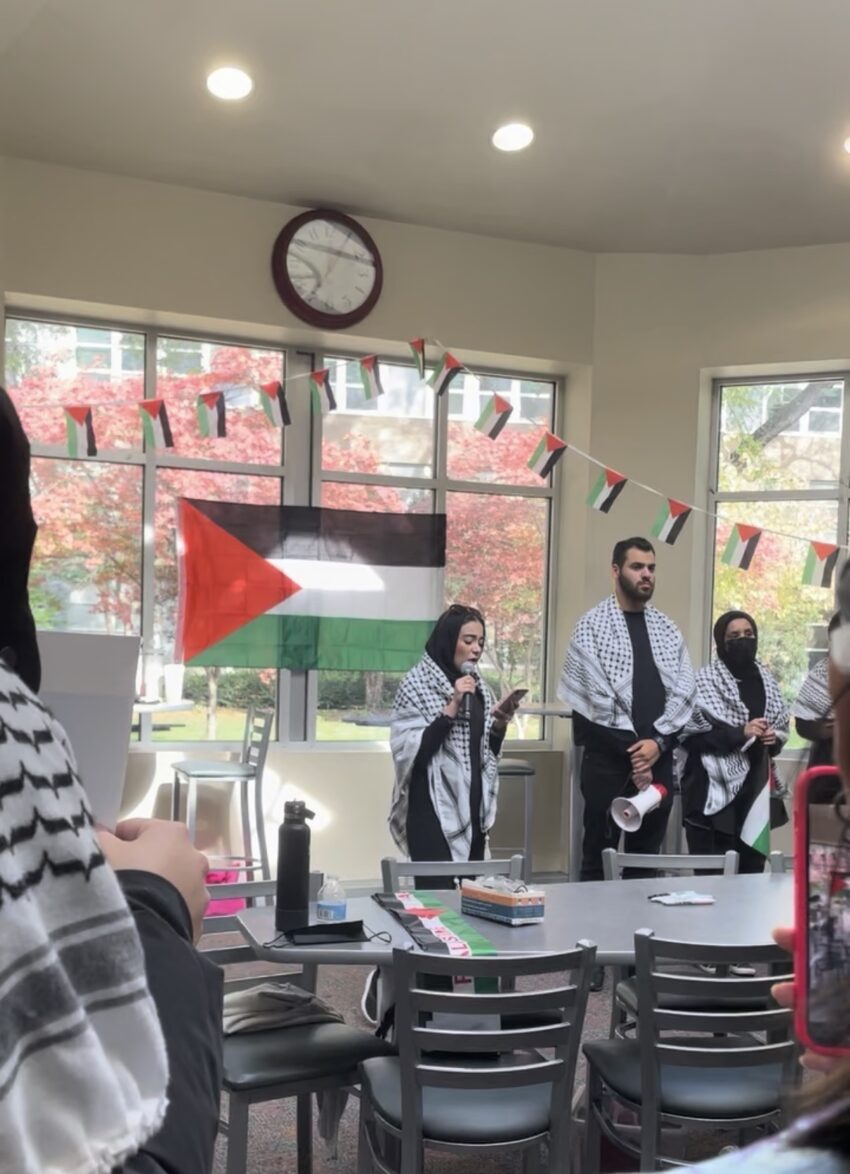
Majid Matariyeh, Jena Kanaan, and Yasmin Abdullah, all SXU ‘24, during an SJP demonstration in front of the Warde Academic Center, October 18, 2023
The Xavierite
People love to say that free speech is alive and well on college campuses. On paper, that might be true. But when major political issues arise, the reality feels very different.
Students don’t always feel free to protest, gather, or even speak openly without thinking about the consequences first. That gap between what free speech is supposed to be and what it actually looks like on campus is hard to ignore.
Free speech, especially under the First Amendment, is meant to protect people from government interference. But that protection doesn’t always translate the same way on college campuses, especially private ones.
Private universities are not held to the same constitutional standards, which means they have more control over what is allowed and how students can express themselves. Students quickly learn that there are limits, even if those limits are not always clearly stated.
One of the clearest examples of this is how protests are handled.
On many campuses, students aren’t even allowed to call what they’re doing a “protest.” Instead, they’re told to label it a “demonstration,” follow strict guidelines, and often get approval beforehand.
That alone changes the nature of what free expression is supposed to be. Protesting is meant to be urgent and responsive, not something that has to be filtered through administrative language and approval processes.
Lately, the fear has gone beyond just school policies.
With increased attention around immigration enforcement and the presence of U.S. Immigration and Customs Enforcement, students are thinking twice before speaking out.
There is a real concern that if universities become sites of visible protest, they could also become targets. For many students, especially those from immigrant families or mixed-status households, that fear is not abstract. It feels immediate and personal.
Because of that, even organizing something as simple as a protest starts to feel risky. Students have to consider not just school consequences, but also safety.
What happens if enforcement shows up? What protections are actually in place? And if something does happen, will the university step in, or will students be left to deal with it on their own?
Those questions don’t have clear answers, and that uncertainty alone is enough to silence people.
Universities have tried to respond by offering “Know Your Rights” workshops and resources. Those spaces are important, and there are staff members who genuinely care and want to support students.
But information can only go so far when the fear is still there. Being told your rights doesn’t automatically make you feel protected. It doesn’t erase the anxiety of what could happen if you speak up in the wrong place at the wrong time.
This creates a situation where students are technically allowed to speak, but don’t always feel like they can. And that distinction matters.
Free speech isn’t just about whether something is legally permitted; it’s also about whether people feel safe enough to actually use their voice. When fear, uncertainty, and institutional control are part of the equation, that freedom starts to feel limited.
College campuses are supposed to be places where students engage with real issues, challenge systems, and advocate for change. But when students have to second-guess whether they can even gather or speak without risk, that environment starts to shift.
It becomes less about open expression and more about navigating restrictions.
Free speech on campus isn’t as simple as people make it seem. It’s not just about rights written in policy. It’s about the reality students are living in. And right now, for a lot of students, speaking out doesn’t feel as free as it should.
About Post Author