
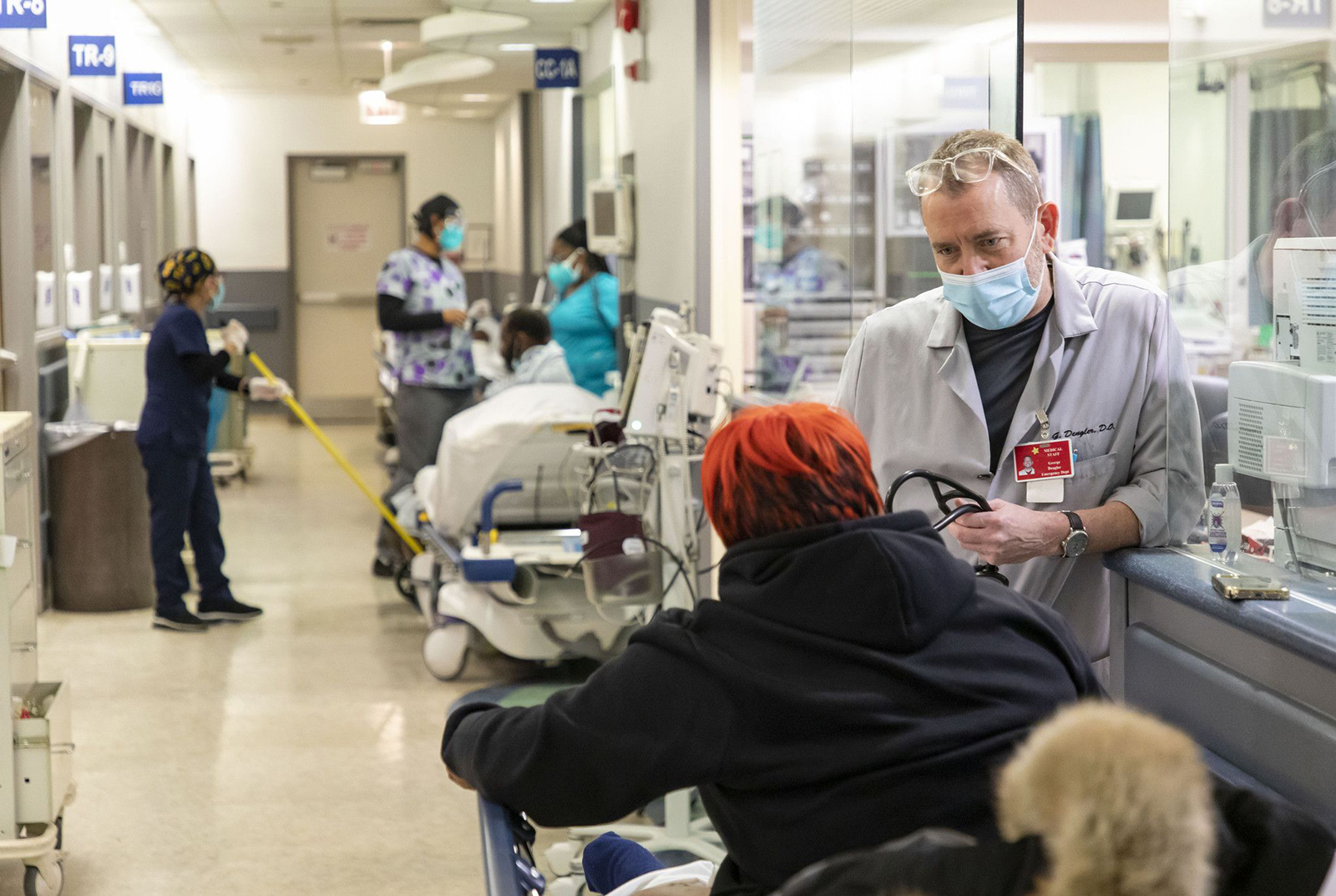
Dr. George Dengler talks to a patient in a hallway where multiple patients sit in beds awaiting available rooms on Jan. 5, 2022, in the emergency department at St. Bernard Hospital in Englewood.
(Brian Cassella/Chicago Tribune/TNS)
Healthcare varies country to country, that much is obvious. However, it’s far from obvious that two areas with the largest discrepancy in life expectancy are Streeterville and Englewood here in Chicago.
In 2019, the Chicago Tribune released an article highlighting the health literacy differences between these neighborhoods–locations just 10 miles apart.
Despite being so close, those living in Streeterville have a life expectancy of 90 years, while Englewood residents face expectancies 30 years shorter, only averaging 60 years.
This happens to be the largest difference between neighborhoods in the entire country, and is almost as large as the largest expectancy difference between countries.
Reasons for this disparity vary, but one outstanding rationale is the racially restrictive infrastructure of the Chicagoland area.
It’s no secret that infrastructure has been used to segregate certain groups.
Highways constructed directly through Black and brown communities, zoning laws used to exclude minority groups, less investment in impoverished areas, and more have all restricted areas from receiving the help they need and deserve.
So how does this translate to a 30 year life expectancy divide?
Englewood has largely become a food and healthcare desert as a result of those limitations.
The Chicago Community Trust voiced the concerns of multiple community members who emphasized their inability to access affordable and healthy food, as well as the challenges of getting seen by medical professionals.
Without the public transportation and number of healthcare facilities seen elsewhere in the country and state, many Englewood residents don’t go to the doctor at all.
This has led to percentages much higher than the average in regards to many illnesses and diseases.
44% of adults in Englewood are obese, compared to the national average of 29.5%. 38% have been diagnosed with high blood pressure compared to the average of 25%, and 17% of those are diagnosed with heart disease.
These numbers alone are shocking, but they are simply the numbers from those who can go to the doctor, not every resident.
While the current life expectancy is a result of years of neglect and unfair treatment, that divide and these percentages are still getting worse despite being known problems.
Englewood is the most prominent example of the health literacy divide in America, but there are countless areas all over our country that are in dire need of help.
Citizens everywhere face restrictions and are unable to gain access to necessities that should be provided to everyone, all because of where they live and how their city was structured.
While we can’t reconstruct entire cities to better support certain areas, we can work together to ensure those areas see an increase in the services they drastically lack.
I don’t want to live in a country where those at the top decide who gets access to what purely because of their skin color or financial standing. Every person deserves a chance at good health, and it’s up to us to ensure that happens.
Read the original article on Chicago’s life expectancy divide here, and reach out to organizations like ILHA (Illinoisans for Healthcare Action) to voice your concerns.
About Post Author
