
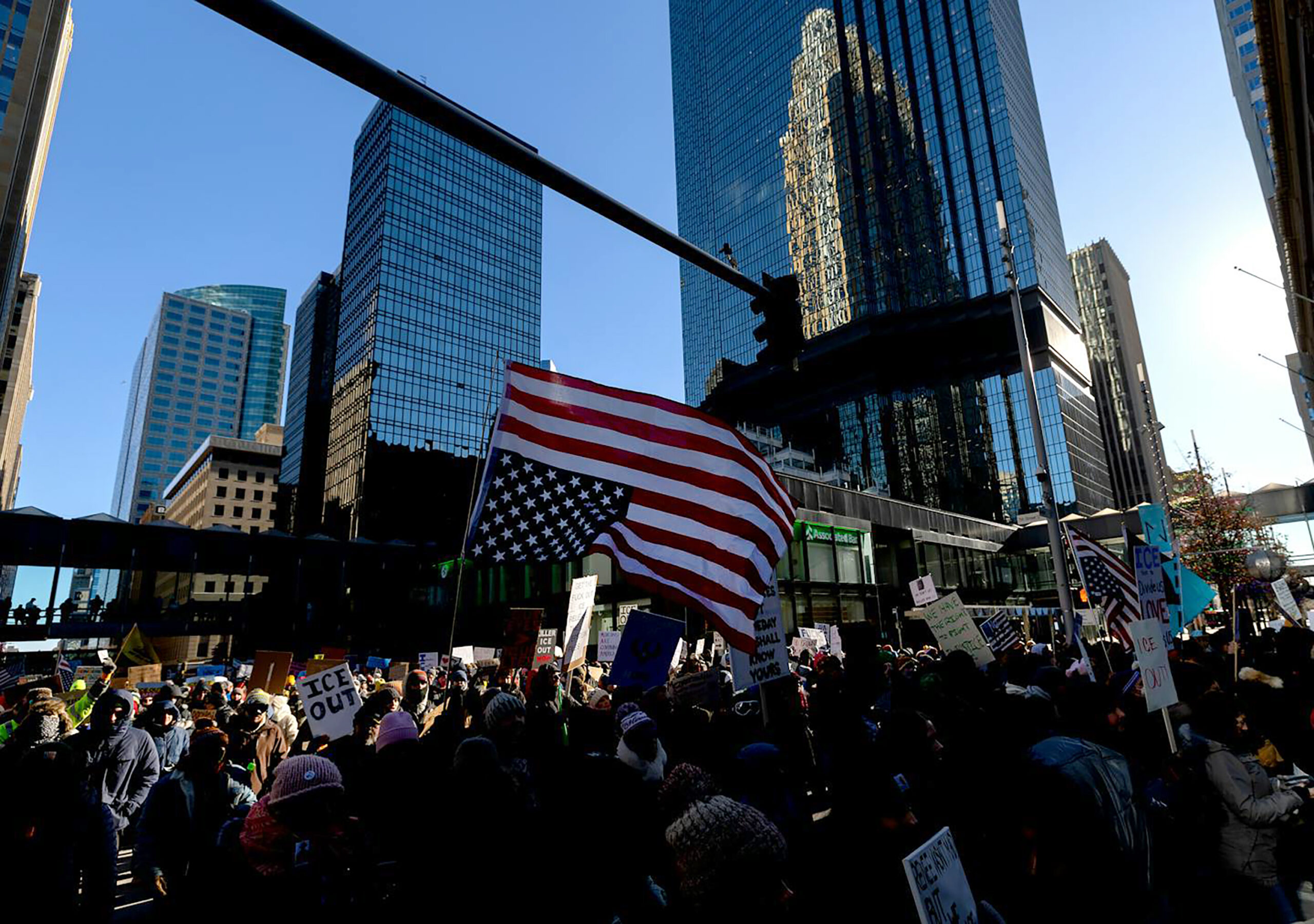
Demonstrators march during an ICE protest in downtown Minneapolis on Jan. 30, 2026.
Carlos Gonzalez/The Minnesota Star Tribune/TNS
Our generation is more politically aware than ever before. We see political news every day when we open social media, whether it is on TikTok, Instagram, or X. We are constantly exposed to discussions about student loan debt, the cost of living, climate change, and social justice. Unlike previous generations, politics is no longer something we only hear about on television or in a classroom.
It is part of our everyday lives, especially in Chicago. Politics is in our neighborhoods, in conversations about immigration, education and the safety of our communities. These issues are not distant.
However, despite being informed and aware, many young people still feel politically powerless. It is frustrating to have to choose between two prominent but polarizing political parties in the United States. This frustration leads many young voters to disengage and detach from their civic duty.
We all felt that in this most recent presidential election. Many of us questioned whether either choice truly represented our values, and that uncertainty made disengagement feel easier than participation.
We are all aware of the potential consequences, as we see them constantly on the news and social media. Yet, this generation sometimes feels like there is no ethical or moral choice, so only the option to disengage.
Engaging in voting is important for us because it is a right that people fought hard to secure during the Suffrage Movement and the Civil Rights Movement. Many individuals risked their lives to make sure future generations would have a voice in democracy. Why would people fight so hard for this right if it was not meant to be used? Choosing not to vote ignores the sacrifices that were made to ensure our participation.
When policies do not seem to reflect our needs, it is easy to feel like our voices do not matter. Many college students worry about debt, job security and whether they will be able to afford to live comfortably in the future. When these concerns continue without clear solutions, exhaustion grows.
This creates a cycle where young people feel excluded, and their lack of representation continues.
As a college student, these issues feel very real. Many students, including myself, think about how student debt, job opportunities, and the cost of living will affect our futures. How will I be perceived by society when I, as a minority, work in my field? We are expected to make important decisions about our lives while facing financial and economic uncertainty.
Yet, it often feels like the people making these decisions do not fully understand or prioritize our experiences. This disconnect makes it easy to feel like our generation has awareness, but not power.
While voting is important, I know it is not the only way people participate in politics. Young people are speaking out, raising awareness, and advocating for change in many ways. However, participation does not always guarantee that our voices will be heard or acted upon.
Our generation must understand that political power begins with civic engagement. Real power does not come from one politician, but from a united and informed public that chooses to participate. Democracy only works when people use their voices.
That means going beyond headlines and social media posts, seeking out reliable information, and educating ourselves on the issues that shape our lives. It means reading different perspectives, asking questions, and refusing to remain passive. No one should have the luxury of being disengaged from the world around them, especially when the decisions being made today have a direct impact on our future.
Our generation cannot afford to confuse awareness with action. If we want change, we must be willing to participate in the process that makes change possible. Our voices are powerful, but only if we choose to use them.
Still, our generation is not apathetic. We care deeply about the issues that affect our lives and our future. We are informed, engaged and willing to participate. Young people deserve to feel like their voices matter and the first step is using them. Political awareness should come with political power.
About Post Author