

Professor Grobmeier, Ed.D., in the House Chamber of the U.S. Capitol building on Feb. 12
Cyndi Grobmeier, Ed.D.
On Thursday, Feb. 12, Saint Xavier University (SXU) Communication professor and Director of Faculty Development Cyndi Grobmeier, Ed.D., along with fellow members of the American Society of Transplantation (AST), traveled to Washington, D.C. to speak with Congress about implementing more research and innovation for immunosuppressive medications that transplant recipients take to avoid transplant rejection.
Grobmeier is the president of a nonprofit organization, Maddog Strong, that raises awareness about and advocates for organ and tissue donation. Grobmeier spoke at the meeting as the mother of an organ donor– her daughter, Maddie, passed away suddenly from an asthma attack the day after her eighteenth birthday, and the organization was created by her parents in her honor.
Due to her heavy involvement in the organ and tissue donation space, Grobmeier became the second donor family representative for the Transplant Community Advisory Council (TCAC) of the AST, which, according to the AST website, “focuses on the Society’s pillars of advocacy, education, organ donation, research, and service to the community through the lens of the patient.”
Grobmeier describes the hearing: “They had a lot of voice in terms of transplant patient representation, but they also wanted to get the other perspective–so, myself and a living donor, [Zachary Sutton], were both invited to speak to our perspectives on how important it is for the transplant recipients to be able to have access to therapies that are going to help them thrive, not just survive. I think that was one of the key takeaways.”
Grobmeier also explained that there has been a lack of progress and innovation in terms of immunosuppressive medication in comparison to other areas of healthcare, noting how there has not been a new immunosuppressant therapy approved by the Food and Drug Administration (FDA) since 2012.
“Most transplant recipients are on a drug–the nickname is ‘tacro’–that drug’s been around for over thirty years. […] It’s not because it’s the greatest drug ever–they’re just still using it because there has not been enough drive to innovate in this space, and pharmaceutical companies need incentive. They need to know that the drugs they bring to the market are going to be profitable because they’re for-profit companies, and there just hasn’t been that incentivization in the transplant space to make that happen,” Grobmeier explained.
Grobmeier noted that while these drugs “are doing their job in terms of protecting the transplanted organ from being acutely rejected,” “they’re not helping patients in terms of long-term, chronic rejection and all of the other things that they face because of the side effects of these medications.”
The Communication professor reported that there was one House Rep. that she knew of present from Nebraska, who she says “was very moved” by what was discussed during the hearing.
“One of the gentlemen who presented did have a meeting with Tammy Duckworth’s health staffers afterwards, and they were very supportive,” Grobmeier recounted, noting how soon-to-be retiree Illinois Senator Dick Durbin, Duckworth’s longtime colleague, has also been a significant source of support over his 29-year tenure as senator.
Grobmeier says the committee’s next plans involve recruiting senators and representatives to reach out to the FDA about the issues raised during the Feb. 12 Congressional hearing on the AST’s behalf.
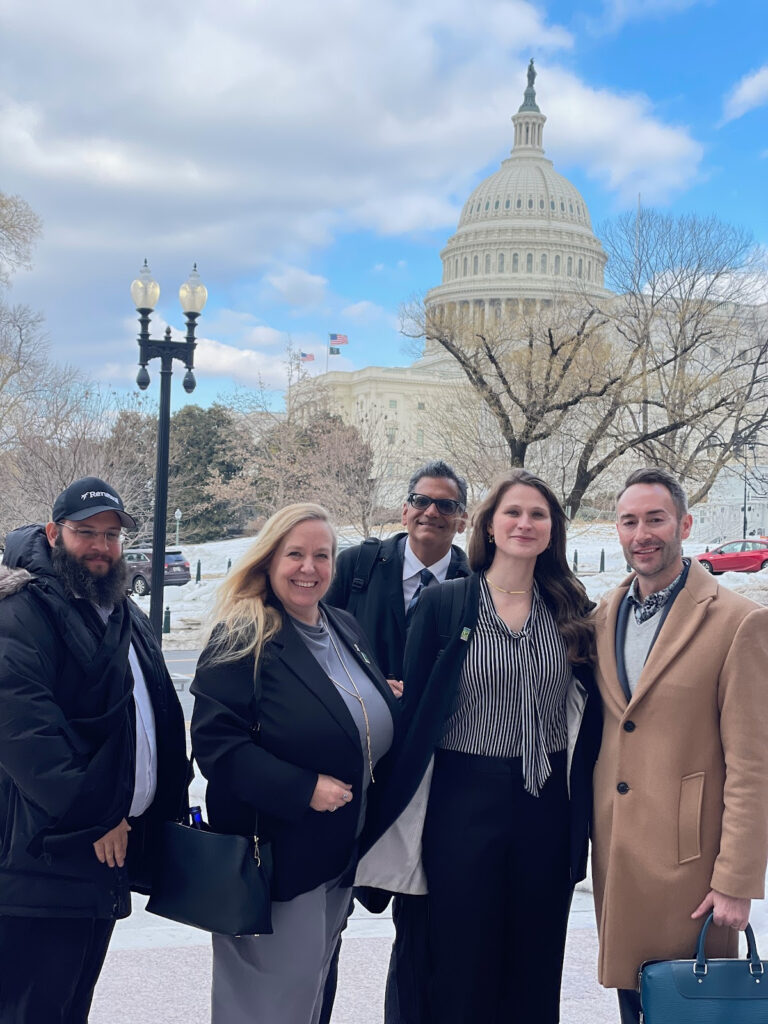
Grobmeier, second from left, with living donor Yosef Telsner (far left), kidney transplant surgeon Dr. John Gill (center), living donor and AST Transplant Community Program Manager Brooke Iarkowski (second from right), and heart recipient Tyler Chavez (far right) outside the U.S. Capitol Building on Feb. 12
Cyndi Grobmeier, Ed.D.
**Correction: “Yaisef” changed to “Yosef” in second photo caption; changed “Ph.D.” to “Ed.D.” for both photo sources and first photo caption**
About Post Author