
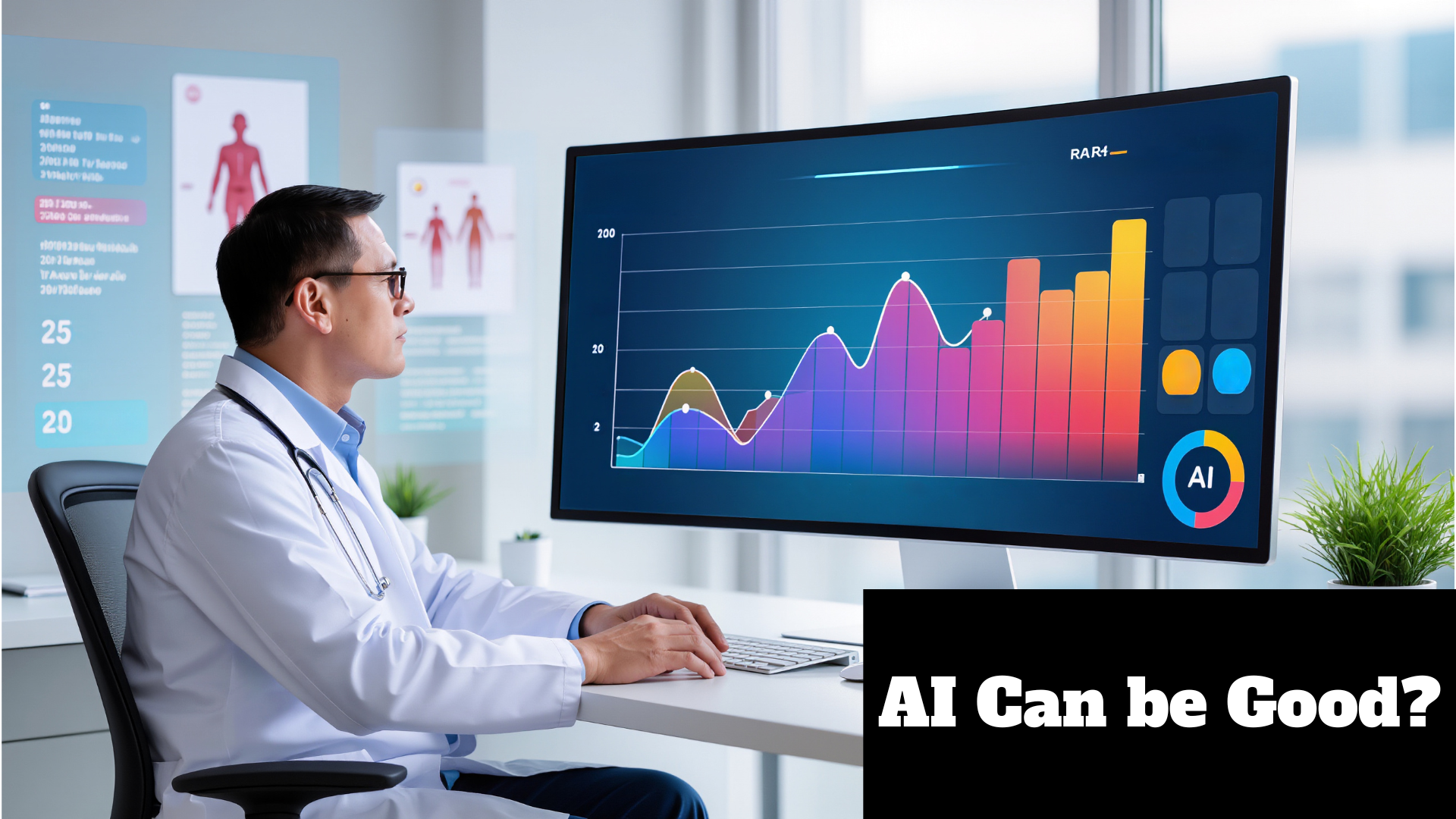
Canva Graphic depicting healthcare
Brian Raica, Jr.
Edited with Canva
Although it is controversial, artificial intelligence (AI) has done wonders for the healthcare industry.
According to an article by Lisa D. Ellis, a researcher at Harvard Medical School, algorithms are incredibly practical to clinicians. These algorithms are able to analyze both patients and their family members’ medical histories to see if there is anything that doctors should watch out for.
Additionally, AI takes pattern recognition to a whole new level, allowing it to identify irregularities from image files alone. An editorial from the University of St. Augustine for Health Sciences mentions an example through the eyes of dermatology, where AI can analyze images of skin lesions and be able to determine what kind they are.
Along with being able to identify these irregularities, it does so at an incredible speed. Meanwhile, at the University of Michigan Medicine, researchers created an AI tool able to detect cancerous brain tumors within ten seconds.
On top of being a tool for identification for doctors, AI can also assist patients in instances when doctors are unable to speak to them.
Doctors and providers are notoriously busy and tired, and some do not have the best communication skills with patients. Some doctors work twelve hour shifts, and feel burned out towards the end.
Healthcare-empowered AI has the ability to determine exactly what kind of healthcare someone needs based on their symptoms, family history, and habits.
It also has the ability to summarize the effects that medication has on one’s health. In fact, AI is now able to determine what side effects medications would have on individuals and how severe those effects would be.
Patients might be in luck when it comes to long waits in the emergency room. According to studies, AI-based triage systems reduce the time from diagnosis to treatment up to twenty percent.
AI also is able to break language barriers. Applications such as Google Translate are now able to provide instantaneous communication exchanges between people. Previously, people served as translators, but were not always accurate.
We live in a frightening time where AI programs are developing on an hourly basis. However, it is nice to know that statistics back up the fact that it is helping us for the better in healthcare. Doctors will never be replaced, but the assistance that AI provides for them is extraordinary.
About Post Author