
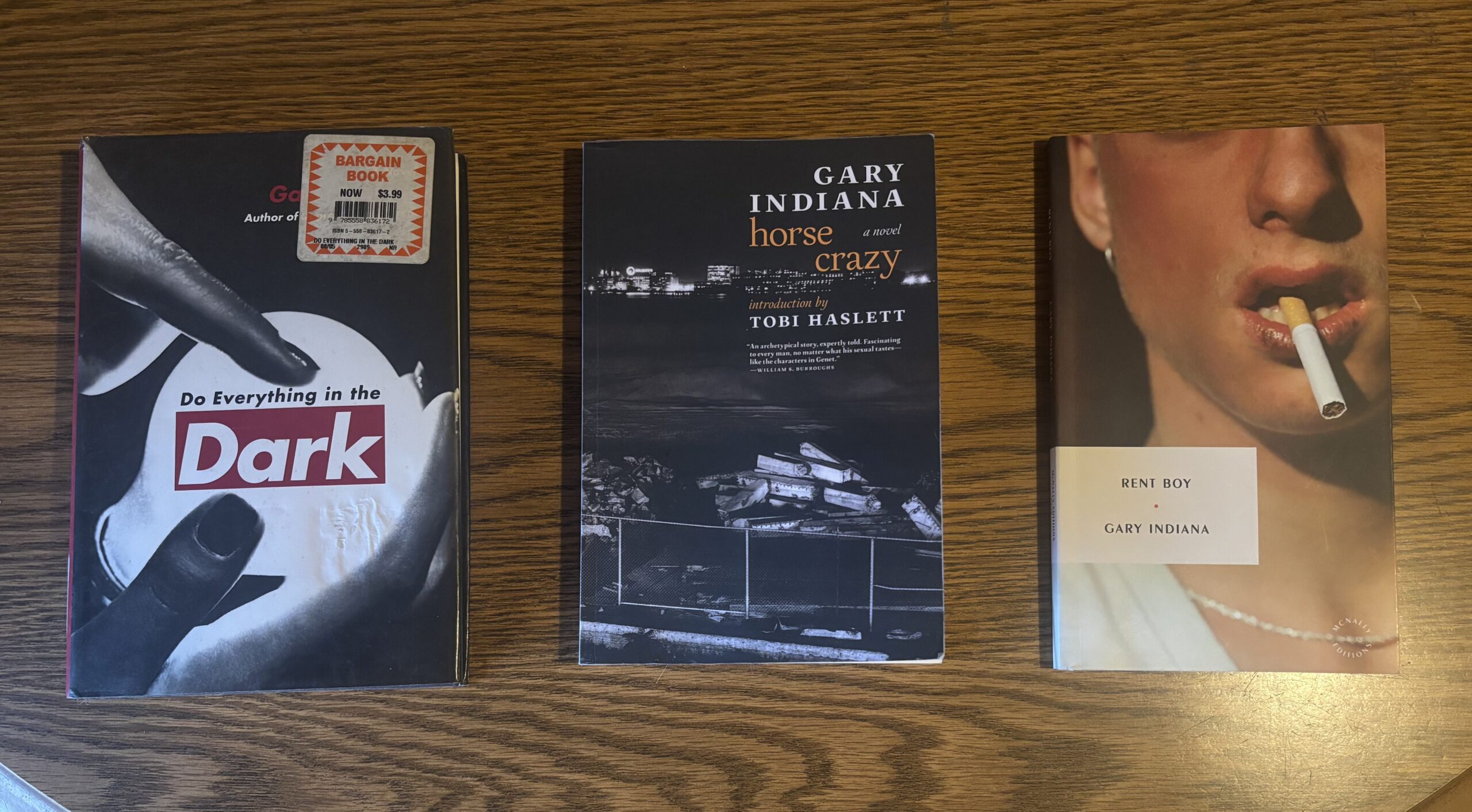
Three novels by Gary Indiana
The Xavierite
Back in December, I impulsively bought a novel by an author I’d never heard of: Gary Indiana. Since then, I’ve read three of Indiana’s novels and fallen in love with his bold and provocative writing.
The initial novel I purchased by Indiana was “Rent Boy,” originally published in 1994. The story takes place in New York City circa 1991 and follows Danny, an architecture student and prostitute who chronicles the gruesome goings-on of his life.
“Rent Boy” is a car crash you can’t look away from. Every sharp sentence evokes the same vague unease you feel after seeing crushed metal and shattered glass on the side of the road. It’s a very short read—less than 150 pages—but that hardly means it’s an easy one.
Without giving too much away, I wouldn’t recommend “Rent Boy” to the faint of heart. It’s a crime novel at its core, and Indiana refuses to keep his writing refined, polite, or sensitive.
John Self, book critic and lead fiction reviewer for The Critic, described the novel as “literature with the filter off.” I can’t think of a more accurate description; Indiana truly crosses every line and pushes every limit with his work.
At times, I had to put “Rent Boy” down because I was genuinely nauseated. The description of Danny’s sexual escapades is graphic enough, but even more disturbing is his spiral into the crime world and reluctant involvement in an underground organ-harvesting scheme.
I know what you’re probably thinking: who in their right mind would read this, let alone write it? However, there’s something to be said about artists who refuse to be restrained by what society deems acceptable.
My (probably morbid) fascination with Indiana’s work stems from its singularity. I’ve never read anything like it, and I doubt I’ll ever read anything like it in the future.
Countless books being published right now read as a regurgitation of the same tropes and aesthetics. Indiana’s work reminds me that there’s still space for out-of-the-box, unapologetic stories.
Although Indiana’s work can be appalling in its obscenity, it’s not without substance or depth. “Rent Boy” isn’t just an exercise in shock-value; it’s a queer, anti-capitalist story that doesn’t play by the rules.
“[The government] no longer feeds the hungry, it doesn’t house the homeless, it lets the streets and the city fall into ruin. Its only purpose is to keep money in the hands of the people who have always had all the money, and to keep everyone else under control,” a character in the novel explains.
Indiana’s greatest strength may be his ability to seamlessly intersperse scathing cultural criticism throughout a narrative. Captivated by his style, I knew I wanted to read more of his work after I finished “Rent Boy.”
I read “Do Everything in the Dark” next, and it became my favorite of the three Indiana novels I’ve read.
“Do Everything in the Dark” follows multiple characters who are all connected through shared misery. They all know the main narrator in some capacity, and they’re all enduring their own respective personal/professional crises.
In this novel, Indiana pulls back on the depravity in favor of unflinching character studies. The narrator’s cynicism highlights Indiana’s dogged honesty in depicting the human condition.
While other authors may be known for rich metaphors, complex characters, or gripping plot twists, Indiana’s calling card is his dedication to truth. His writing shines a stark, near-blinding light on topics we’d rather ignore and forces us to look.
I most recently finished “Horse Crazy,” Indiana’s 1989 novel that follows an obsessive and toxic love affair between two men during the height of the AIDS crisis in New York City.
I enjoyed this novel, but I don’t think it was quite as strong as the other two Indiana novels I read. Its focus on the intersection of love/contagion in the context of sexually-transmitted diseases was moving, but I found the plot to be a bit slow.
Overall, I’d highly recommend Indiana’s work—even, or perhaps especially, if it’s out of your comfort zone. Consuming art that challenges your own boundaries and biases is essential in increasing empathy, compassion, and healthy self-reflection.
Indiana’s work is available for purchase here.
About Post Author