
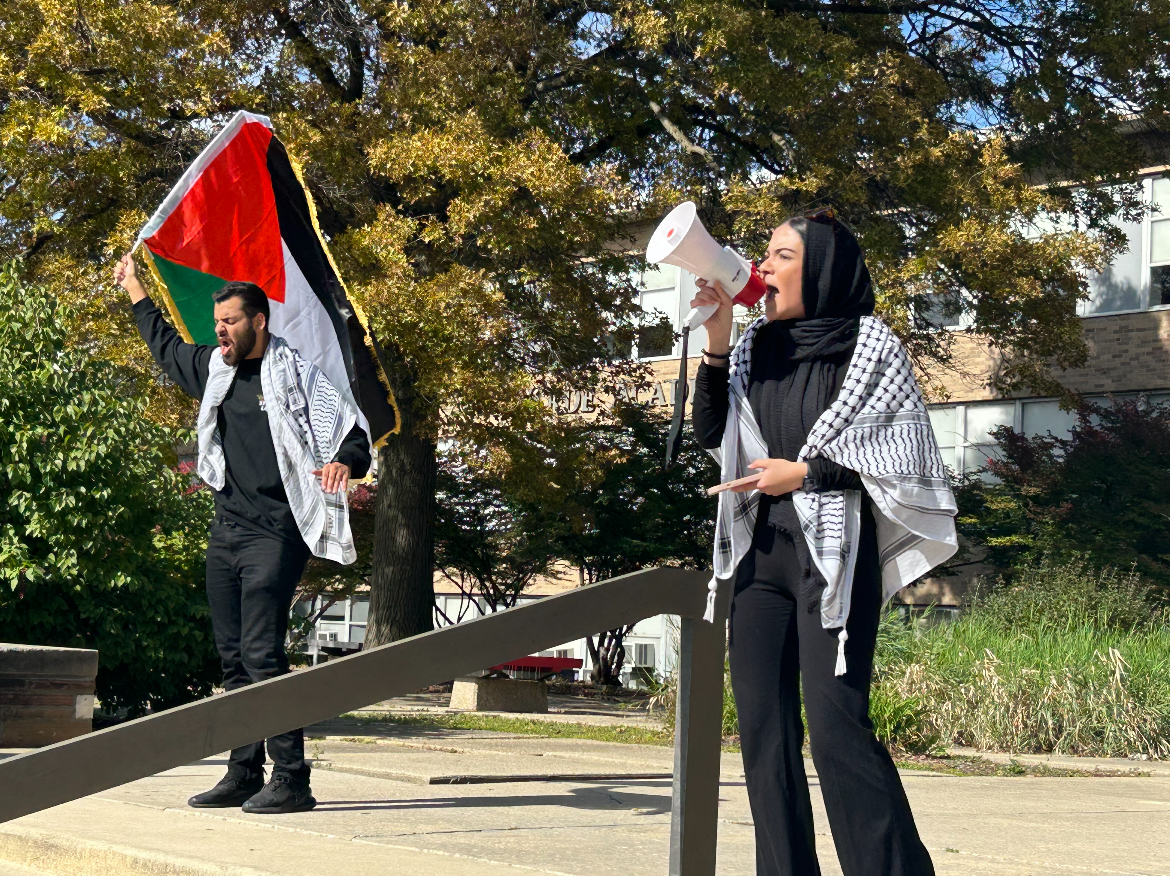
Majid Matariyeh and Jena Kanaan, both SXU ‘24, during an SJP demonstration in front of the Warde Academic Center, October 18, 2023 The Xavierite
Many universities often claim “neutrality” during moments of social and political crisis, but neutrality is not neutral at all. Neutrality is often a privilege–one that prioritizes institutional comfort over the safety and well-being of marginalized students.
When universities refuse to take a stance, they are still making a choice–one that often places reputation, donors, powerful alumni, and public image above their students.
Students often look to their universities as examples of leadership during times of political struggle. Yet, during moments of crisis, the response many students receive is a carefully-worded campus-wide email filled with phrases about “unity” and “peace,” while avoiding any clear stance on what is going on in the world. These messages may appear calming on the surface, but they often fail to address the real fear and uncertainty students are experiencing.
This is what universities label solidarity. For many students, it feels more like abandonment.
Many students do not have the privilege of being unaffected by policy decisions. In Chicago, we are witnessing communities being targeted solely based on race, immigration status, or gender. For institutions of higher education to “wait and see” how political shifts unfold is not only irresponsible, it is unacceptable.
Silence during these moments sends a clear message about whose lives are considered worth protecting.
Students are still expected to attend class, meet deadlines, and perform academically with no exceptions, even when the country their parents were born in is experiencing violence or genocide. At the same time, students are often pushed into demonstrations or “civil discussions” where they are forced to debate their own humanity, while the institutions meant to support them remain quiet.
The burden of advocacy is placed on students rather than on those in positions of power.
Taking a neutral stance can also make many students feel unsafe on campus. As seen in the news, students have put their lives at risk simply by going to class. Some are detained or abducted by U.S. Immigration and Customs Enforcement (ICE) for no reason other than their legal status. In these situations, silence from university leadership does not promote peace; it reinforces fear.
For students whose identities are politicized, neutrality is not “unity.” It is silence in the face of harm.
It is important for all students to understand that universities are not truly neutral actors. Institutions regularly take strong stances when it benefits them, issuing statements about rankings, athletics, fundraising, and institutional success. When accreditation is threatened or enrollment declines, universities act quickly and decisively.
The claim of neutrality only seems to surface when standing up for students might carry political or financial risk. If universities can act boldly to protect their interests, they can act boldly to protect their students.
Peace and freedom of speech cannot exist in spaces where some students feel unsafe simply existing.
About Post Author