
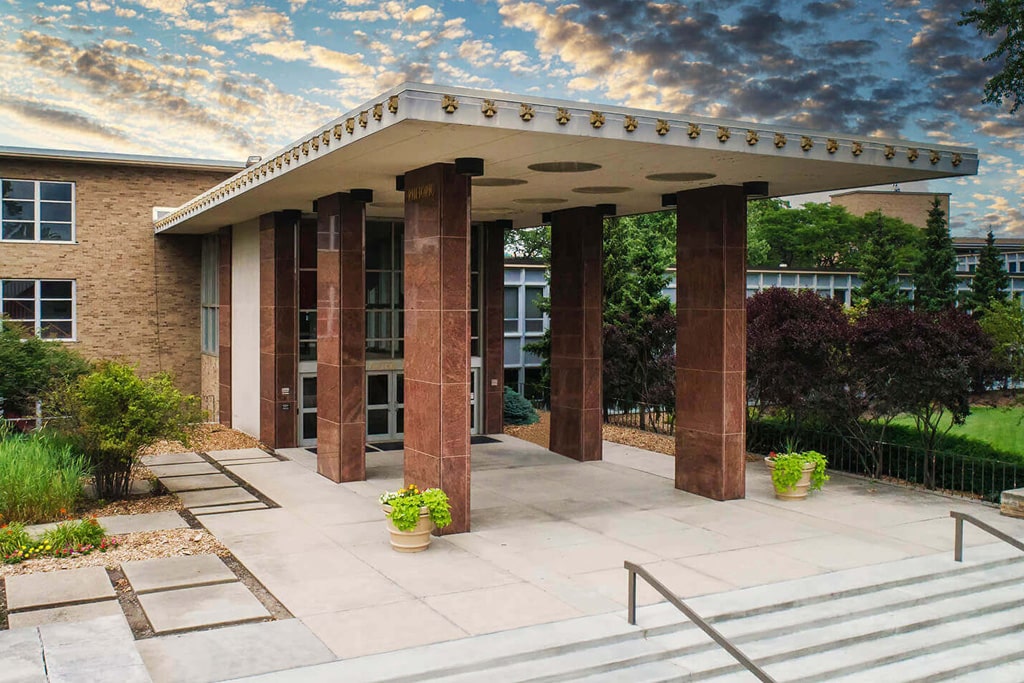
The four pillars in front of the Warde Academic Center SXU News
In recent years, the value of a liberal education has come under increasing attack. Once considered the backbone of higher education, liberal arts majors are now dismissed as impractical, unethical, or financially irresponsible.
Students are warned that pursuing these degrees is a gamble that may not pay off in the job market. This growing skepticism has fueled policy shifts, funding cuts, and institutional decisions that prioritize profit and efficiency over intellectual growth and civic responsibility.
Across the country, states and universities are responding to financial pressures by targeting liberal arts programs. Federal funding proposals, rollbacks of diversity initiatives, and heightened scrutiny of university endowments have created an environment where programs not immediately tied to high-paying careers are deemed dispensable.
What is often left out of this conversation is the deeper cost of these decisions. When institutions cut liberal arts programs, they are not just trimming budgets; they are narrowing the purpose of education itself.
When cuts are made there are less choices to explore more about political science, philosophy, or other world studies in general. This often results in many students taking the same subject with the same professor over and over again.
At Saint Xavier University, this trend became reality in the spring of 2023.
Former Xavierite Deputy Editor-in-Chief Nuala Hanlon, ’24, reported that four majors (Religious Studies, Philosophy, Mathematics, and Actuarial Science) were eliminated from the university’s list of available programs. These cuts sent a clear message: certain fields of study were no longer worth maintaining.
Liberal arts degrees are often portrayed as disconnected from workforce needs, but this claim ignores the skills these disciplines cultivate. Critical thinking, ethical reasoning, effective communication, and adaptability are not luxuries; they are essential in a rapidly changing job market.
Employers repeatedly emphasize the value of graduates who can analyze complex problems, collaborate across differences, and think beyond the box. Ironically, these are exactly the skills that liberal arts education emphasizes.
The consequences of these cuts fall disproportionately on first-generation students. For many, college is not just about securing a job, it is about gaining access to knowledge, confidence, and social mobility.
Limiting academic options sends the message that only certain paths are “worth” pursuing, reinforcing existing socioeconomic inequalities. First-generation students should not be boxed into narrow definitions of success dictated by short-term economic logic.
Education should not be reduced to a transactional exchange where degrees are valued only by their monetary value. Universities have a responsibility to prepare students not only for their first job, but for a lifetime of learning, leadership, and civic engagement.
Liberal arts education fosters informed citizens who can question power, understand diverse perspectives, and contribute meaningfully to society. Preserving liberal arts programs is not about nostalgia, it is about defending the integrity of education itself.
Students deserve the freedom to pursue disciplines that challenge them to think deeply, act ethically, and participate fully in our democracy.
About Post Author