
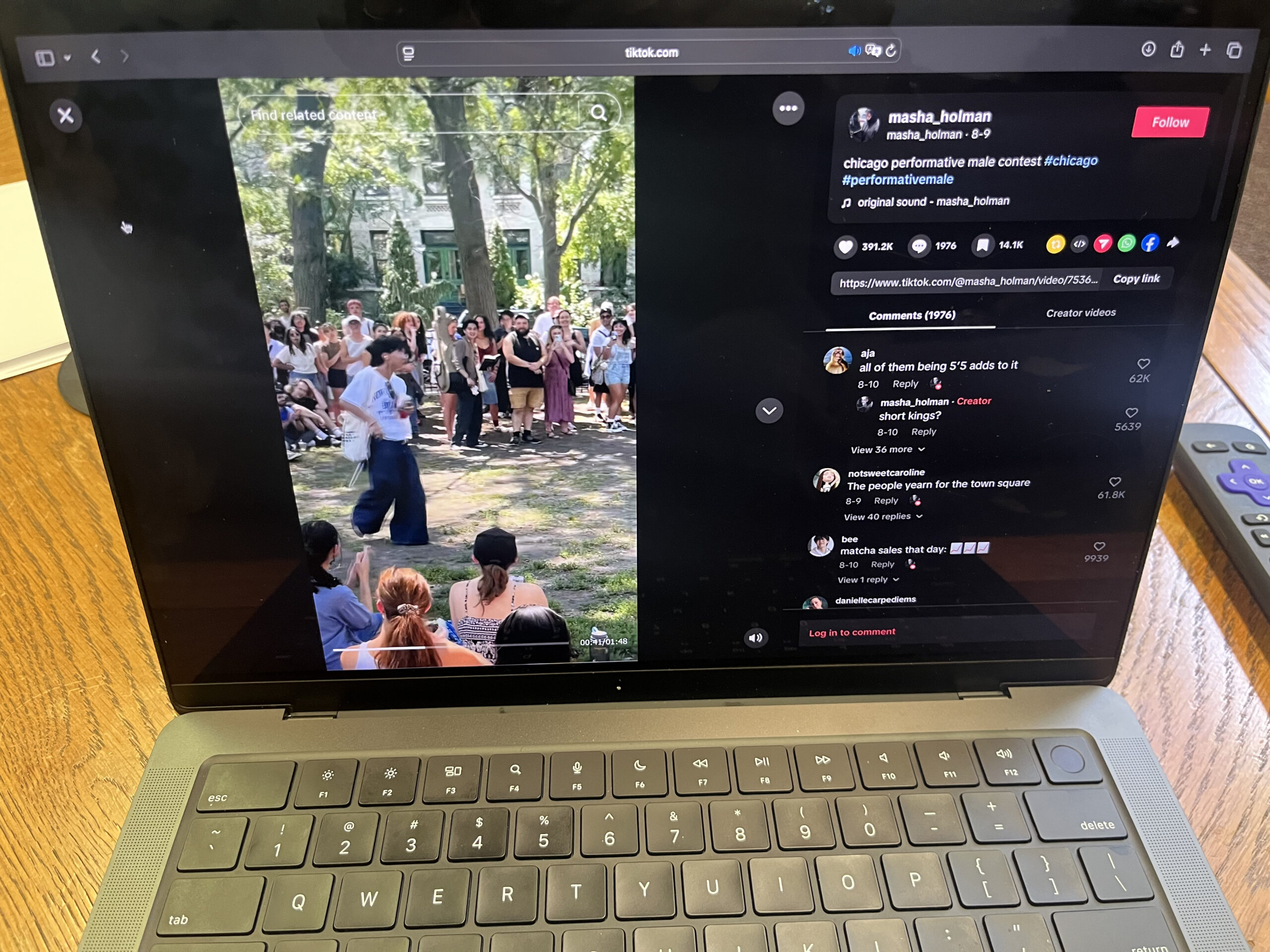
There’s been an insurmountable amount of ridiculous trends over the last few years, but none have brought people together more than the many “contests” held throughout the US’ major cities. The most recent being the “performative male” contest in Chicago.
For those who feel that they just read an incoherent jumble of words, the “performative male” contest was held on August 9th at Wicker Park. Competitors had to prove they were the better “performative male” through jester-like performances mimicking a type of man many feel are inauthentic.
The classic “performative male” is stereotypically associated with matcha, tote bags, books they’ve never read, clairo, an extensive collection of physical media, and an affinity for surface level feminism.
In simpler terms, a performative man is a man who vies for women’s attention in a peacocking way that comes across as inauthentic and cheap.
The contest itself was highly endearing and well-documented through a multitude of IikToks and other social media posts. Ironically, an article I discovered on the event by Charles Thrush stated the winner of the contest was a woman named Meaghan Morris.
Contestants often recited similar lines, pulling out books from tote bags and reassuring the audience that they most definitely read every single one.
The performative male contest is only one of many, even just in Chicago. Past contests in Chicago include a Jeremy Allen White lookalike contest as well as a Joe Keery lookalike contest.
Lookalike contests are well known as the starting point of this contest craze, beginning with the Timothée Chalamet lookalike contest in Manhattan, New York. Contenders for the win ranged from “Wonka” Timothee all the way to “Dune” Timothée.
At this point, many may wonder why these contests have become such a cultural phenomenon. Many signs point to it being a result of the increasing lack of community and community spaces.
As many say, “the people yearn for third spaces.” The lack of third spaces in recent years is an entire conversation in itself, but the lookalike contests only reaffirm this.
The United States is known for its clique-y, individualistic culture, but most within it do long to feel connection and belonging. People want a reason to bond over something silly, to be with their community.
It’s something I’ve personally discussed often in college, especially as I reach my final years. Many of my peers have expressed they worry they won’t have many opportunities to be as social or involved post graduation.
Something unique about college is it almost forces you to have community, especially when it comes to events. I thought about this more after realizing these contests are quite reminiscent of events on our own campus.
One event that immediately came to mind was the annual “grito” contest that usually takes place around Hispanic Heritage Month, which is every year from Sept. 15 to Oct. 15. The concept itself is a bit silly, but the event is always one of the most memorable.
I often catch myself thinking about how much I’ll miss college events and the unique atmosphere they bring once I graduate. I’m sure this likely resonates with many others, and I think this applies to the effectiveness of these contests in bringing people together.
One comment that’s really stuck to me after researching these contests is, “this has to be a recession indicator.” This was likely intended to be no more than a joke, but I think it rings true here.
The performative male contest (as well as majority of the lookalike contests) was completely free, which I think attributes to the major turn out events like these have.
More and more events have fees to enter or for specific things within them, which can be a major turn off for those who are already struggling to make ends meet.
I know for myself and many of my peers, fees at certain events can immediately make us turn right around at the door. The majority of the time, my friends and I will attend an event simply because it is free.
Ironically, it is also one of the more organic events to come out as of late despite its focus on performativity. There’s something quite appealing about an event that’s not so perfectly curated that it intimidates you.
About Post Author