
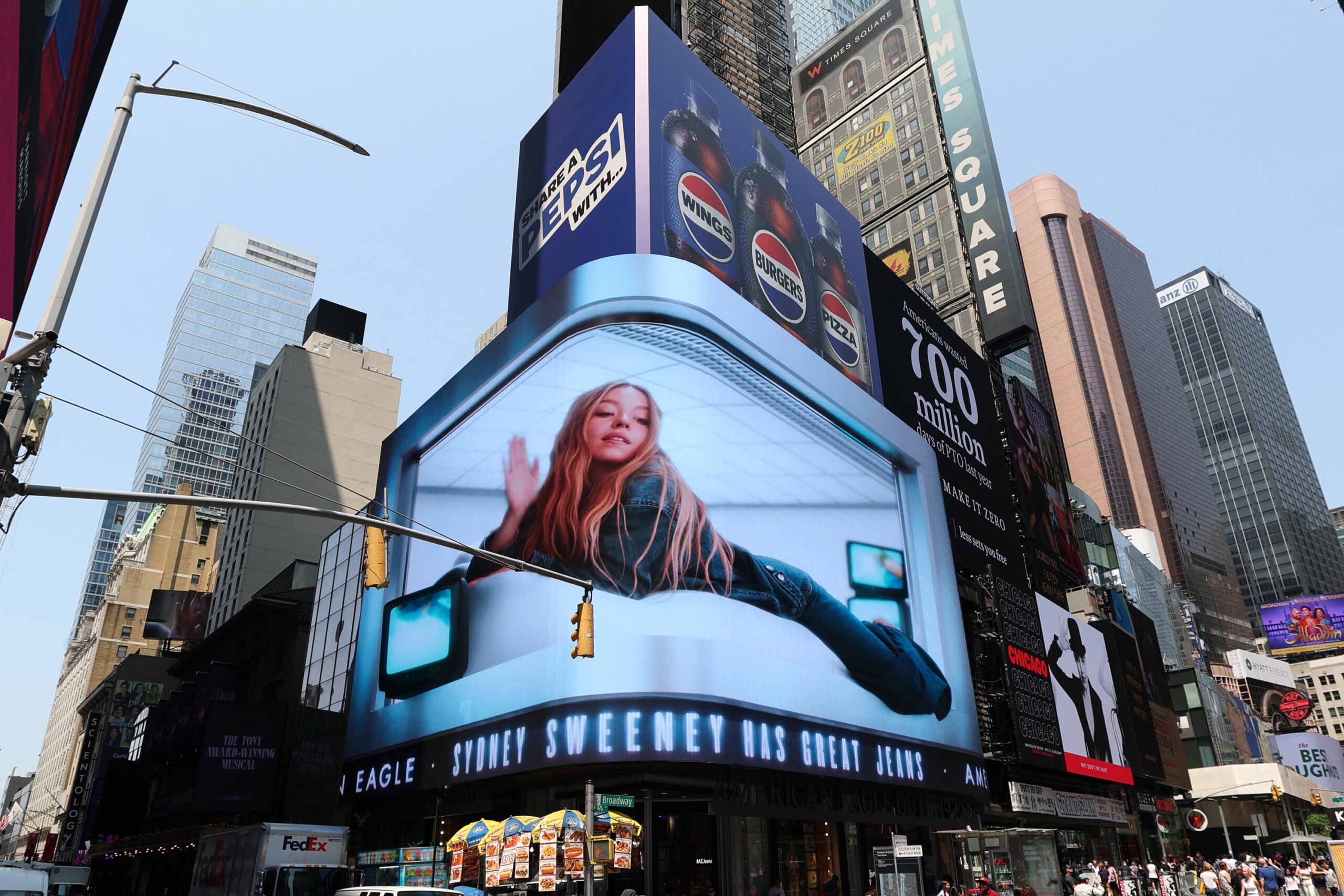
Over the past few months, notable denim brands American Eagle, Levi’s, and Gap have been in somewhat of an advertisement war. Within our current culture and political climate, it’s important to remember none of these ads exist in a vacuum.
It all started back in July, when American Eagle launched its collaboration campaign with actress Sydney Sweeney. The campaign was titled “Sydney Sweeney Has Great Jeans” and faced immediate backlash.
In a video promoting the campaign, Sweeney lays back with her jeans unbuttoned and talks about how genes determine different physical attributes and personality traits.
The wordplay with “genes” and “jeans” raised flags for many people. Some claimed the ad evoked ideas of eugenics—a discredited theory popularized by white supremacists which says the human race could be improved by breeding out “undesirable” traits.
Others criticized the ad for being overly sexual. Sweeney’s video campaign overtly pays homage to a Calvin Klein ad from 1980 which infamously sexualized fifteen-year-old Brooke Shields. Many found it concerning that American Eagle would reference an ad which intentionally sexualized a minor.
Sweeney is no stranger to sexualizing herself and pandering to the men who objectify her. Her collaboration with Dr. Squatch was under similar fire after she released her own “bath water soap.”
Whether American Eagle’s campaign was ill-intentioned or not, it comes off as grossly irresponsible at best.
Conservatism is on the rise, and our president is vehemently against diversity, equity, and inclusion (DEI) programs. It’s troubling that a company wouldn’t consider how its campaign about a blonde, blue-eyed woman’s genes would sit within our current culture.
The backlash became so passionate that it made headlines and even the president decided to weigh in. Trump voiced his approval and appreciation for the ad on his social media platform, Truth Social, describing it as the “HOTTEST ad out there.”
After the controversy of American Eagle’s ad campaign, other denim brands latched onto the opportunity to showcase what their brands represent in opposition.
Levi’s jeans released an ad campaign days after Sweeney’s which starred Beyoncé. Beyoncé’s been in collaboration with Levi’s for some time now, but it’s safe to say the rollout of their newest campaign was strategic.
Beyoncé’s campaign differed in several major ways. For one, the ad itself was much more artistic. The main video of the campaign included different set designs, costumes, and a storyline. It also never once mentioned genetics, instead choosing to focus on the jeans themselves.
Levi’s covert clapback to American Eagle only added fuel to the controversy fire.
Gap joined the conversation when they released their collaboration campaign with popular girl group Katseye in August. In their video campaign, the girls of Katseye dance to 2000s hit “Milkshake” by Kelis while sporting different denim styles.
Katseye’s campaign proceeded to go viral. According to Gap’s CEO Richard Dickson, the “Better in Denim” campaign garnered twenty million views in the first three days, 400 million total views, and eight billion total impressions.
Although Katseye is new to the spotlight, they seem to know their values. They’ve also collaborated with Lush Cosmetics in the past—a brand known for their advocacy for causes like animal rights, LGBTQ+ rights, and Palestinian freedom.
Although Gap’s campaign didn’t directly reference American Eagle’s, their overt diversity only highlights American Eagle’s lack thereof.
Katseye is a truly global and diverse group with members from South Korea, Switzerland, the U.S., and the Philippines. Just within their short video campaign, the amount of different ethnicities being represented is a stark contrast to American Eagle.
Representation matters in the movies and TV shows we watch, but it also matters in the ads we see in magazines or plastered in store windows.
American Eagle’s campaign stirred up negativity more than anything else. Gap’s ad, however, made a genuine positive impact.
In this Instagram post, a mom going back-to-school shopping with her daughter saw Gap’s campaign in stores, and the ad’s inclusion of Indian representation struck an emotional cord.
“Beauty is universal,” she said in the post’s caption.
Some might argue that ad campaigns “aren’t that deep.” Shouldn’t it just be about the jeans?
Ignorance truly is bliss. If it’s not obvious why we need diverse representation now more than ever, I would consider reading up on the news lately.
Everything around us is informed by our culture and politics. Every piece of media, including ad campaigns, serve as a reflection of our societal circumstances. As consumers, it matters what brands we give our money to.
Should we support companies trying to break boundaries, further equality, and promote inclusion? Or, should we support companies that are careless with the subtext of their ads and double down when confronted with their insensitivity? It’s up to the individual to decide, but I would recommend the former.
About Post Author