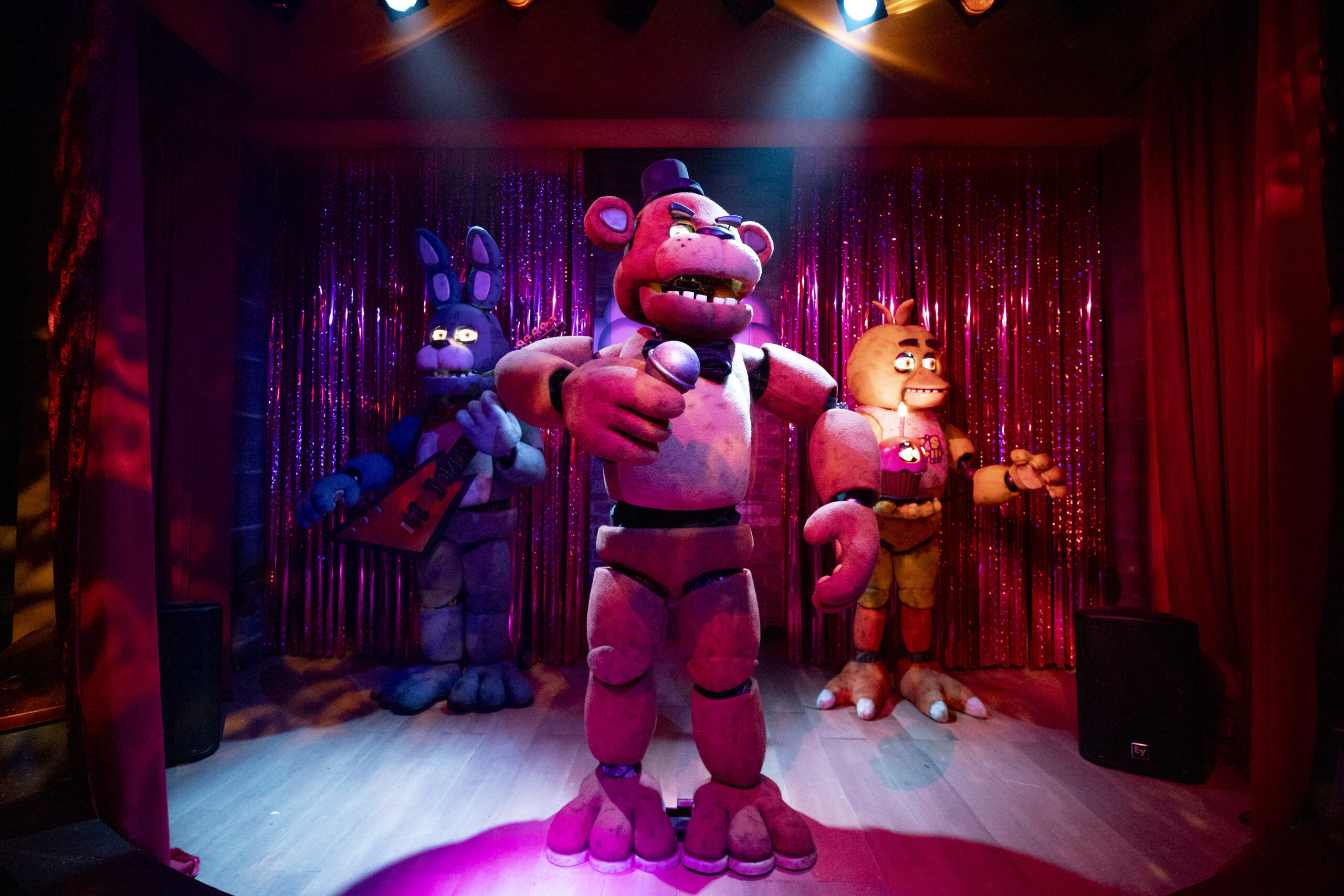
The Five Nights at Freddy’s house makes creepy animatronics come to life during Universal’s Halloween Horror Nights at Universal Studios on Aug. 29, 2025. Patrick Connolly/Orlando Sentinel/TNS
If you ask any Gen Z kid about Five Nights at Freddy’s, odds are they’ll have a story. Maybe it’s the memory of playing the first game on an old laptop at midnight, heart racing as Freddy Fazbear’s eyes flashed on the screen. Or maybe it’s still being deep in the fandom today. Collecting plushies, cosplaying at conventions, or scrolling through endless YouTube theory videos trying to make sense of the ever-expanding lore.
For over a decade, the series has managed to terrify, delight, and utterly consume the imaginations of players young and old.
What started as a small indie horror game in 2014 has become one of the most recognizable multimedia franchises of the last decade. In the eleven years since its release, Five Nights at Freddy’s has transformed from a simple jump-scare simulator into a cultural phenomenon.
The franchise now boasts 28 video games (11 main games, 7 spin-offs, 6 expansions, and even 4 infamous “troll” games), 51 books ranging from novels and anthologies to graphic novels and guidebooks, a horror attraction, Snapchat filters, crossovers, a mountain of merchandise, and yes–a feature film.
And with a second movie set to hit theaters this December, Freddy Fazbear fever clearly isn’t slowing down anytime soon.
Part of what’s kept Five Nights at Freddy’s alive for so long is how it’s grown up alongside its fans. What began as a creepy late-night game for middle schoolers has turned into a full-fledged fandom of artists, theorists, and creators.
Every new release sends fans spiraling into speculation mode, zooming in on teaser posters, dissecting hidden dialogue, and piecing together a timeline that seems to get more complicated with every chapter. The thrill of being “in the know” is as addictive as the games themselves, and the community is a core reason the franchise has remained relevant.
And let’s be honest: that’s half the fun. The FNaF universe is basically the internet’s version of a murder-mystery board, with clues buried in minigames, sound files, and even source code.
Fans decode cryptic animatronic behaviors, theorize about who or what haunts each location, and endlessly debate the true story behind the possessed robots. The lore is intricate, sometimes maddening, and utterly fascinating. This level of fan investment has helped keep the franchise alive in a way few indie games ever achieve.
Of course, the original Five Nights at Freddy’s formula is why it all took off in the first place. A player alone in a security booth, flicking through security cameras, desperately conserving power as animatronics crept closer. No weapons, no escape–just pure, slow-building panic. Its minimalist approach to horror, focusing on atmosphere, timing, and sound design rather than gore or complex mechanics, set it apart from other games at the time. The sudden jumpscares were legendary memes and screams from bedrooms across the internet cemented the game in pop culture.
The series has evolved since that first game, introducing new mechanics, locations, and characters, but the core concept remains: tension, uncertainty, and fear of the unseen. Spin-offs and expansions have experimented with alternate gameplay styles, from first-person shooters to narrative-driven experiences, keeping long-time fans on their toes while giving new players multiple ways to enter the universe. And while some titles have been polarizing, the franchise’s ability to innovate without losing its identity is a big part of why it’s endured.
Beyond the gameplay, Five Nights at Freddy’s has become a cultural touchstone. From fan art on Tumblr to TikTok dance challenges with animatronic masks, from midnight gaming sessions to schoolyard debates over canon, the franchise has seeped into nearly every corner of internet culture.
Even parents who’ve never played a game can recognize Freddy Fazbear’s grin, which is proof that this series is more than a niche phenomenon.
And then there’s the storytelling, subtle yet compelling. Between the jumpscares lies an unsettling narrative: missing children, haunted robots, and shady backstories. This storytelling has sparked endless discussion, fanfiction, and even academic analysis about horror, fear, and the psychology of play.
Some players are drawn as much to solving these mysteries as they are to surviving the scares themselves a dual appeal that bridges casual gamers and obsessive theorists alike.
Now, with the upcoming sequel film, the franchise is poised to reach yet another audience. While skeptics question how a pixelated indie game about haunted animatronics could translate to the big screen, fans are already speculating about how the film will handle the lore, the scares, and the iconic animatronics.
Whether the movie succeeds or fails, it’s proof of the franchise’s lasting influence: a game series created by one developer now exists as a shared cultural experience across generations.
Over eleven years, Five Nights at Freddy’s has proven that horror can be fun, immersive, and community-driven. It’s not just a game–it’s a memory, a theory puzzle, a conversation starter, and for millions of fans, a rite of passage. From pixelated panic to elaborate storytelling, the series has carved out a permanent place in pop culture.
As fans prepare for another sleepless night at Freddy Fazbear’s Pizza this December, one thing is clear: whether you’re jumping out of your chair at a sudden scare, theorizing about a hidden minigame, or sharing memes about Golden Freddy, Five Nights at Freddy’s isn’t going anywhere. And maybe that’s the scariest and best part of all.